Keywords:
complex, ligand
Ziegler-Natta polymerization is a method of vinyl
polymerization. It's important because it allows one to make polymers
of specific tacticity. It was discovered by two
scientists, and I think we
can all figure out what their names were. Ziegler-Natta is especially
useful, because it can make polymers that can't be made any other way,
such as linear unbranched polyethylene and isotactic
polypropylene. Free radical
vinyl polymerization can only give branched polyethylene, and
propylene won't polymerize at all by free radical polymerization. So
this is a pretty important polymerization reaction, this Ziegler-Natta
stuff.
So then how does it work? Something like this: Take your
Ziegler-Natta catalyst, usually TiCl3 or TiCl4, along with an aluminum based co-catalyst, and place in
the
monomer at midnight on the night of the full moon. Then place the beaker
on the ground in a circle of lighted candles, and then write the word
"isotactic" or "syndiotactic", depending of the tacticity you desire, in
runic letters on
the side of the beaker with the blood of a freshly slain goat.
The goat must be less than one year old, and without blemish.
Then one must recite aloud the Ziegler-Natta incantation seven times,
followed by the tacticity dance. If the polymerization is successful, a
cold and violent wind
will quickly arise and extinguish the candles, and then die away as
quickly as it arose. It is important that one
fast for three days before and after carrying out the ceremony. Following
this little procedure usually does the trick.
Ok, so that's not really how it works, but our knowledge of how
Ziegler-Natta polymerization works, and why one initiator system will work
better than another is rather limited. Picking the right conditions to
make a Ziegler-Natta polymerization work often feels more like magic than
science. But we do know a little bit. We know that it involves transition
metal catalyst, like TiCl3. We also know that
co-catalysts are involved, and these are usually based on group III
metals like aluminum. Most of the time our catalyst/co-catalyst pair are
TiCl3 and Al(C2H5)2Cl, or TiCl4 with
Al(C2H5)3.
 To make things simple, we'll worry about the
TiCl3 and Al(C2H5)2Cl
system. It helps to know something about TiCl3 to
know how the system works to make polymers. TiCl3
can arrange itself into a number of crystal structures. The one that
we're interested in is called α-TiCl3. It look something like this:
To make things simple, we'll worry about the
TiCl3 and Al(C2H5)2Cl
system. It helps to know something about TiCl3 to
know how the system works to make polymers. TiCl3
can arrange itself into a number of crystal structures. The one that
we're interested in is called α-TiCl3. It look something like this:
 As we can see, each titanium atom is coordinated to six chlorine atoms,
with octahedral geometry. That's how titanium is happiest, when it's
coordinated to six other atoms. This presents a problem for the titanium
atoms at the surface of the crystal. In the interior of the crystal, each
titanium is surrounded by six chlorines, but on the surface, a titanium
atom is surrounded on one side by five chlorine atoms, but on the other
side by empty space!
As we can see, each titanium atom is coordinated to six chlorine atoms,
with octahedral geometry. That's how titanium is happiest, when it's
coordinated to six other atoms. This presents a problem for the titanium
atoms at the surface of the crystal. In the interior of the crystal, each
titanium is surrounded by six chlorines, but on the surface, a titanium
atom is surrounded on one side by five chlorine atoms, but on the other
side by empty space!
 This leaves poor titanium a chlorine short. Can't it just deal with
it and get on with its life? Well, no. You see, titanium is one of
those transition metals, and what do we know about transition metals? We
know that they have six empty orbitals (resulting from one 4s and
five 3d-orbitals) in their outermost electron shells. To be happy,
titanium has to be coordinated with enough atoms to put two electrons in
each of the orbitals. The titanium atom on the surface of the
crystal has enough neighbor atoms to fill five of the six
orbital.
We're left with an empty orbital, shown as an empty square in the
picture below.
This leaves poor titanium a chlorine short. Can't it just deal with
it and get on with its life? Well, no. You see, titanium is one of
those transition metals, and what do we know about transition metals? We
know that they have six empty orbitals (resulting from one 4s and
five 3d-orbitals) in their outermost electron shells. To be happy,
titanium has to be coordinated with enough atoms to put two electrons in
each of the orbitals. The titanium atom on the surface of the
crystal has enough neighbor atoms to fill five of the six
orbital.
We're left with an empty orbital, shown as an empty square in the
picture below.
 Now this state of affairs can't go on. That titanium wants to fill its
orbitals. But first,
Al(C2H5)2Cl enters the picture. It
donates
one of its ethyl groups to the impoverished titanium, but kicks out one of
the chlorines in the process. We still have an empty orbital.
But more about that in a moment.
Now this state of affairs can't go on. That titanium wants to fill its
orbitals. But first,
Al(C2H5)2Cl enters the picture. It
donates
one of its ethyl groups to the impoverished titanium, but kicks out one of
the chlorines in the process. We still have an empty orbital.
But more about that in a moment.
 As you can see in this picture, the aluminum has a hard time letting go.
It stays coordinated, though not covalently bonded, to the CH2
carbon atom of the ethyl
group it just donated to the titanium. Not only that, but it also
coordinates itself to one of the chlorine atoms adjacent to the titanium.
But titanium still has one empty orbital left to be filled.
As you can see in this picture, the aluminum has a hard time letting go.
It stays coordinated, though not covalently bonded, to the CH2
carbon atom of the ethyl
group it just donated to the titanium. Not only that, but it also
coordinates itself to one of the chlorine atoms adjacent to the titanium.
But titanium still has one empty orbital left to be filled.
So then a vinyl monomer like propylene comes along. There are two
electrons in the π-system of a carbon-carbon double bond. Those
electrons can be used to fill the empty orbital of the titanium. We say
that the propylene and the
titanium form a complex, and we draw it like this:
 But complexation is a rather complicated process, not nearly as simple as
this picture implies. Those who want the whole story can read how this
complexation works, and those who want the short
version, can skip straight to the polymerization:
But complexation is a rather complicated process, not nearly as simple as
this picture implies. Those who want the whole story can read how this
complexation works, and those who want the short
version, can skip straight to the polymerization:
This is where it starts to get interesting. Suppose at this point that a
vinyl monomer showed up, let's say, a molecule of propylene. The titanium
is going to enjoy this. To understand why, let's take a look at vinyl
monomer, specifically, its double bond. A carbon-carbon double bond, is
made up of a σ bond and a π bond. We're going to take a closer look at that
π bond.
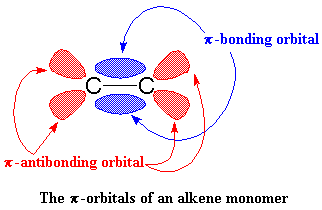 Take a look at the picture and you'll see that the π
bond consists of two π-orbitals. One is the π-bonding orbital (shown in
blue) and the other is the π-antibonding orbital (shown in red). The
π-bonding orbital has two lobes sitting between the carbon atoms, and
the π-antibonding orbital has four lobes, sticking out away from the
two carbon atoms. Normally the pair of electrons stays in the π-bonding
orbital. The π-antibonding orbital is too high in energy, so under
normal circumstances it's empty.
Take a look at the picture and you'll see that the π
bond consists of two π-orbitals. One is the π-bonding orbital (shown in
blue) and the other is the π-antibonding orbital (shown in red). The
π-bonding orbital has two lobes sitting between the carbon atoms, and
the π-antibonding orbital has four lobes, sticking out away from the
two carbon atoms. Normally the pair of electrons stays in the π-bonding
orbital. The π-antibonding orbital is too high in energy, so under
normal circumstances it's empty.
Let's look again at titanium for a moment. This
picture shows titanium and two of its outermost orbitals. (Yes, it has
more than two, but we're only going to show two right now for clarity.)
 One of the titanium orbitals that we've shown is that
empty orbital.
It's made of the green lobes. The pink lobes are one of the filled
orbitals. That empty orbital is going to look for
a pair electrons, and it knows just where to look. It knows that the
alkene's π-bonding orbital has a pair that it will share. So the
alkene's π-bonding orbital and the titanium's d-orbital come together and share a pair of electrons.
One of the titanium orbitals that we've shown is that
empty orbital.
It's made of the green lobes. The pink lobes are one of the filled
orbitals. That empty orbital is going to look for
a pair electrons, and it knows just where to look. It knows that the
alkene's π-bonding orbital has a pair that it will share. So the
alkene's π-bonding orbital and the titanium's d-orbital come together and share a pair of electrons.
 But once they're together, that other orbital (the
pink one) comes mighty
close to that empty π-antibonding orbital. So the titanium orbital and
the π-antibonding orbital share a pair of electrons, too.
But once they're together, that other orbital (the
pink one) comes mighty
close to that empty π-antibonding orbital. So the titanium orbital and
the π-antibonding orbital share a pair of electrons, too.
 This additional sharing of electrons makes the complex stronger. This
complexation between the alkene and the titanium sets things up for the
next step of the polymerization.
This additional sharing of electrons makes the complex stronger. This
complexation between the alkene and the titanium sets things up for the
next step of the polymerization.
Part One: Isotactic Polymerization
The precise nature of the complex between the titanium and the propylene
is complicated. So to make things simple we're going to just draw it like
we
did
earlier from now on, like this:
 This is a nice complex, neatly solving the problem titanium had with its
d orbitals not having enough electrons. But it can't go on like
this. You see, that complex isn't going to stay that way forever. Some
electron shuffling is going to happen. Several pairs of electrons are
going to shift positions. You can see the shifting in the picture below:
This is a nice complex, neatly solving the problem titanium had with its
d orbitals not having enough electrons. But it can't go on like
this. You see, that complex isn't going to stay that way forever. Some
electron shuffling is going to happen. Several pairs of electrons are
going to shift positions. You can see the shifting in the picture below:
 We don't know exactly which pairs shifts first,
but we think the first to move is that pair from the carbon-carbon p-bond that is complexed with the titanium. It's
going to shift to form simple titanium-carbon bond. Then the electrons
from the bond between the titanium and the carbon of the ethyl group that
titanium got from Al(C2H5)2Cl. This pair of electrons is
going to shift to form a bond between the ethyl group and the
methyl-substituted carbon of the propylene monomer. Got that? It's kind
of tricky to put into words, but we end up with the structure you see on
the right side of the picture up there.
We don't know exactly which pairs shifts first,
but we think the first to move is that pair from the carbon-carbon p-bond that is complexed with the titanium. It's
going to shift to form simple titanium-carbon bond. Then the electrons
from the bond between the titanium and the carbon of the ethyl group that
titanium got from Al(C2H5)2Cl. This pair of electrons is
going to shift to form a bond between the ethyl group and the
methyl-substituted carbon of the propylene monomer. Got that? It's kind
of tricky to put into words, but we end up with the structure you see on
the right side of the picture up there.
What happens next is what we call a migration. We don't know why
this happens, we just know it happens. But the atoms rearrange themselves
to form a slightly different structure, like this:
 The aluminum is now complexed with one of the carbon atoms from our
propylene monomer, as you can see. As you can also see, titanium is back
where it started, with an empty orbital, needing electrons to
fill it.
The aluminum is now complexed with one of the carbon atoms from our
propylene monomer, as you can see. As you can also see, titanium is back
where it started, with an empty orbital, needing electrons to
fill it.
So when another propylene molecule comes along, the whole process starts
all over, and the end result is something like this:

and of course, more and more propylene molecules react, and our polymer
chain grows and grows. Take a look at the picture, and you'll see that
all the methyl groups on the growing polymer are on the same side of the
chain. With this mechanism we get isotactic polypropylene. For some
reason, the incoming propylene molecule can only react if it's pointed in
the right direction, the direction that gives isotactic polypropylene.
We're not sure why this happens, we just know that it happens.
If you want to see a movie of isotactic Ziegler-Natta polymerization,
click
here!
Part Two: Syndiotactic Polymerization
The catalyst system we just looked at gives isotactic polymers. But other
systems can give syndiotactic polymers. The one we're going to look at is
based on vanadium rather than titanium. That system is
VCl4/Al(C2H5)2Cl. It looks
like the picture you see on the left, not too different from the titanium
system we just looked at. But to simplify things, during this little
discussion we're going to just draw what you see on the right.
 This complex will act pretty much the same way as the titanium system does
when a propylene molecule comes its way. First the propylene complexes
with the vanadium, then the electrons shift just like before, and the
propylene is inserted between the metal and the ethyl group, just like
before. This is all shown in the picture below.
This complex will act pretty much the same way as the titanium system does
when a propylene molecule comes its way. First the propylene complexes
with the vanadium, then the electrons shift just like before, and the
propylene is inserted between the metal and the ethyl group, just like
before. This is all shown in the picture below.
 but you can also see an important difference in this picture. Remember
how with the titanium system, the growing polymer chain shifts positions
on the titanium atom? You'll notice that doesn't happen here. The
growing
polymer chain stays in its new position. That is, until another propylene
molecule comes along. This second propylene reacts while the growing
chain
is still in its new position, just like you see below:
but you can also see an important difference in this picture. Remember
how with the titanium system, the growing polymer chain shifts positions
on the titanium atom? You'll notice that doesn't happen here. The
growing
polymer chain stays in its new position. That is, until another propylene
molecule comes along. This second propylene reacts while the growing
chain
is still in its new position, just like you see below:
 But notice that when the second propylene adds to the chain, the chain
changes position again. It's back in the position where it started. Take
a look at the methyl groups of the first monomer, in blue, and the second
monomer, in red. Notice that they're on opposite sides of the polymer
chain. When the growing polymer chain is in one position the propylene
monomer can only add so that the methyl group is on one side of the chain.
When the chain is in the other position, propylene can only add so that
the methyl group hangs off the other side. We're not exactly sure why
this is. But we do know that because the growing polymer chain switches
positions with each propylene monomer added, the methyl groups end up on
alternating sides of the chain, giving us a syndiotactic polymer.
But notice that when the second propylene adds to the chain, the chain
changes position again. It's back in the position where it started. Take
a look at the methyl groups of the first monomer, in blue, and the second
monomer, in red. Notice that they're on opposite sides of the polymer
chain. When the growing polymer chain is in one position the propylene
monomer can only add so that the methyl group is on one side of the chain.
When the chain is in the other position, propylene can only add so that
the methyl group hangs off the other side. We're not exactly sure why
this is. But we do know that because the growing polymer chain switches
positions with each propylene monomer added, the methyl groups end up on
alternating sides of the chain, giving us a syndiotactic polymer.
If you'd like to see a movie of how syndiotactic Ziegler-Natta
polymerization takes place, click here!
Limitations
Ziegler-Natta polymerization is a great way to make polymers from
hydrocarbon monomers like ethylene and propylene. But it doesn't work of
for some other kinds of monomers. For example, we can't make poly(vinyl chloride) by Ziegler-Natta polymerization.
When the catalyst and cocatalyst come together to form the initiating
complex, radicals are produced during intermediate steps of the reaction.
These can initiate free radical polymerization
of the vinyl chloride monomer. Acrylates are
out, too, because Ziegler-Natta catalysts often initiate anionic vinyl polymerization in those monomers.
Moving Forward
For a long time, Ziegler-Natta polymerization was the most useful and
versatile reaction for producing polymers of a specific desired tacticity.
But recently a new type of polymerization, also using metal complexes as
initiators, has been developed, called metallocene
catalysis polymerization. It's hot, so go read about it!

 این وبلاگ توسط دانشجوی ارشد شیمی پلیمر جهت ارائه جدید ترین مطالب در مورد شیمی راه اندازی شده است. امیدوارم بتوانم سهمی هرچند کوچک در گسترش این علم داشته باشم