روشهای تصفیه آب

روشهای تصفیه آب

آب آشامیدنی 

آب‌های آشامیدنی را از چشمه ها ، قنات ها و یا چاه ها استخراج می‌کنند. بنابراین ، برای تولید بیشتر آب ، می‌توان چاه‌های بیشتری ساخت. باران و دریا هم از دیگر منابع آبی هستند که البته به عنوان آب آشامیدنی مناسب نیستند. این گونه آب‌ها را باید تصفیه نمود. روش های معروف تصفیه آب ، تقطیر و جوشاندن می‌باشند.


تصفیه آب و فاضلابها 

آب و فاضلابها برای استفاده و برای برگشت به محیط یا استفاده مجدد نیاز به تصفیه دارند. روشهای مختلفی برای تصفیه آبها و فاضلابها وجود دارد که بسته به مصارف آب و نوع آلودگی از این روشها استفاده می‌شود. عمده‌ترین‌ روشهای تصفیه آب عبارت‌اند از:

  • تصفیه مکانیکی آب 
  • تصفیه شیمیایی آب 
  • تصفیه آب به روش اسمز معکوس 
  • تصفیه بیوشیمیایی آب 
  • فیلتراسیون آب


فرآیند تصفیه آب در تصفیه خانه های شهری

فرآیند تصفیه آب

عملکرد تصفیه از ابتدای ورود به تصفیه خانه که از نوع پلساتور است تا انتهای خروجی یک ساعت بطول می انجامد و شامل مراحل زیر است:

  • کلر زنی مقدماتی در بندهای انحرافی سدها
  • کلرزنی ابتدائی در ورودی تصفیه خانه 
  • افزودن مواد شیمیائی و اختلاط سریع
  • اختلاط آرام، انعقاد و ته نشینی در پلساتورها
  • فیلتراسیون
  • کلرزنی انتهائی

کلرزنی مقدماتی

به منظور ضد عفونی خطوط انتقال آب که محل مناسبی برای رشد میکروارگانیسم ها است، در بندهای انحرافی کلر به میزان لازم به آب اضافه می شود.

کلرزنی ابتدایی 

پس از ورود آب در ابتدای ورود به تصفیه خانه، کلر که به فرآیند تصفیه نیز کمک می نماید به میزان لازم و با توجه به حجم و کیفیت آب ورودی توسط کلریناتورهای گازی با نظر آزمایشگاه به آب اضافه می شود.


افزودن مواد شیمیایی 

برای ته نشینی ذرات معلق موجود در آبهای سطحی و زلال سازی از مواد شیمیائی بنام منعقد کننده استفاده می شود. این مواد عبارتند از : کلرورفریک(منعقد کننده اصلی) ، پلی الکترولیک(کمک منعقد کننده) ، و آب آهک (تنظیم کنندهPH ) که پس از رقیق سازی در مخازن شیمیائی بوسیله پمپهای تزریق در حوضچه فلاش میکسر به آب اضافه می گردد. در این حوضچه یک دستگاه همزن برقی برای اختلاط سریع مواد شیمیائی با آب نصب شده است. 


ته نشینی 

آب پس از اختلاط با مواد منعقد کننده وارد پلساتورها می شود و مراحل کواگولاسیون(انعقاد ذرات معلق) و فلوکولاسیون(تشکیل لجن) را طی می کند در انجام این مراحل دستگاه واکیوم چمبر که با وارد کردن ضربات پی در پی به آب باعث اختلاط آرام در حوضها می شود بسیار موثر است. ابرهای لجن تشکیل شده در اثر اختلاط آرام پس از ته نشینی در حوضچه هائی بنام هپر، بطور اتوماتیک با فاصله های زمانی معین در کانالهای منتهی به حوضچه تغلیظ لجن تخلیه و پس از جدا شدن آب صاف آن به بسترهای لجن خشک کن هدایت می شود. 


فیلتراسیون 

آب خام پس از زلال شدن از طریق کانالهای جمع آوری واقع در سطح پلساتورها وارد فیلترهای تند شنی شده و با عبور از نازلهای تعبیه شده در کف فیلترها بطرف کانالهای خروجی و از آنجا به طرف منابع برای مصرف شهروندان هدایت می شود. این فیلترها پس از عبور آب نسبتا زلال و باقی ماندن ذرات معلق در بین ماسه ها در فواصل زمانی یک تا دو روز توسط پمپهای هوا و آب به صورت بک واش شستشو می شوند


کلرزنی انتهایی در خروجی تصفیه خانه 

مطابق استاندارد آب خروجی تصفیه خانه (که کدورتی کمتر از یک واحد NTU دارد) باید دارای مقداری کلر باقیمانده آزاد (بین PPM 0.8_0.2 ) برای ضد عفونی منابع و خط لوله های انتقال آب تا منازل شهروندان باشد. برای این منظور در خروجی تصفیه خانه نیز کلر توسط دستگاه کلریناتور به آب اضافه می شود. میزان کلر باقیمانده آزاد در خروجی توسط دستگاه کلرسنج به صورت لحظه ای به اتاق کنترل گزارش می شود.


بررسی روش های تصفيه آب خانگی و كاربرد آنها

دستگاههای تصفيه آب خانگی برای حذف يا كاهـش مواد زائد آب آشاميدنی بكار ميروند. اين مواد عمدتا عبارتند از :

  • سختی آب 
  • كلر و تركيبات بيماريزای كلر
  • فلزات سنگين
  • آلودگی های ميكروبی

در زير به بررسی اين پارامترها و روشهای تصفيه آن ها می پردازيم

مواد زائد آب

  • سختی آب 

املاح موجود در آب موجب بالا رفتن سختی آب مي شوند 

تماس آب با تركيبات آهكی موجود در زمين باعث ورود عوامل سختی در آب ها شده و معمولا آب های زيرزمينی از سختی زيادتری نسبت به آب های سطحی برخوردارند. 

سختی آب، عملا شاخص ميزان فعل و انفعال آب با صابون است و برای شستشو با آب های سخت تر به صابون زيادتری نياز است. سختی آب به مجموعه املاح كلسيم و منيزيم موجود در آب بر حسب ميلی گرم در ليتر كربنات كلسيم اطلاق ميشود. 

آب های سخت در درجه حرارت بالا در جداره كتری و ديگ های بخار رسوبات كربنات كلسيم ايجاد ميكنند.

طبقه بندی آب ها از نظر سختی بشرح زير ميباشد :

آب های سبك60-0 ميلي گرم در ليتر

آب های با سختی متوسط120-60 ميلي گرم در ليتر

آب های سخت180-120 ميلي گرم در ليتر

آب های خيلی سختبيشتر از 180 ميلي گرم در ليتر


  • كلـر 

برای ميكروب زدايی، در تصفيه خانه های شهری كلر به آب افزوده ميشود.

كلر و تركيبات آن برای ضدعفونی آب آشاميدنی در تصفيه خانه ها به آب اضافه ميگردد. در سالهای اخير تحقيقات به عمل آمده نشان داده اند كه مواد آلی موجود در آب با كلر تركيب شده و ايجاد تری هالومتان ها، كلرات و ساير تركيبات جانبی مضر و سمی می نمايند كه باعث بروز انواع بيماريهای صعب العلاج در انسان ميگردند.


  • فلزات سنگين 

فلزات سنگين از طريق نفوذ پساب صنعتی در آب آشاميدنی به انسان منتقل ميشوند.

فلزات سنگين با توجه به توسعه شهرنشينی و صنايع كه منجر به افزايش ميزان فاضلاب و پساب شده است، عمدتا از طريق دفع نادرست و غيربهداشتی فاضلاب شهری و پساب صنعتی وارد محيط زيست می گردند. مرگ و ميرهای آبزيان در اثر تخليه پساب های محتوی فلزات سنگين در دنيا و ايران بی سابقه نيست. سبزيجات اطراف تهران نيز كه با فاضلاب آبياری ميشوند از اين آلودگی ها بی بهره نمی باشند. فلزات سنگين شامل سرب، جيوه، روی، نيكل، كرم، كادميوم و غيره ميباشد. وجود فلزات سنگين در غلظت بيش از استاندارد در آب شرب باعث عوارض مختلف نظير مسموميت، حساسيت شديد، ضايعات كروموزومی، عقب افتادگی ذهنی، فراموشی، پاركينسن، سنگ كليه، نرمی استخوان و انواع سرطان ازجمله سرطان پروستات ميگردد. يكی از كارشناسان محيط زيست، آلودگی محيط مخصوصا آب با فلزات سنگين را بعنوان بزرگترين گناهی كه بشر در طبيعت انجام ميدهد ارزيابی نموده است.


  • ميكرواورگانيزم های بيماری زا 

ميكروبها از طريق نفوذ فاضلاب انسانی در آب آشاميدنی به انسان منتقل می شوند.

امراض مختلفی بوسيله آب به انسان منتقل می شوند. از جمله اين امراض می توان وبا، حصبه، اسهال ميكروبی و خونی، هپاتيت، سل، ديفتری، انگلهای خونی و كبدی را نام برد. عوامل بروز اين بيماريها كه شامل تك ياخته ها، ويروس ها، باكتری ها، كرم ها و انگلها می باشند، از طريق نفوذ فاضلاب در آب آشاميدنی به انسان منتقل ميشوند. بيماری های ناشی از آب آلوده سالانه نزديك به يك ميليارد انسان را در روی كره زمين مبتلا می كنند و باعث مرگ حدود 10 ميليون نفر می شوند.

متداول ترين روش های تصفيه آب خانگی به شرح زير ميباشد :

رزين های تبادل يون

برای كاهش سختی آب 

رزين های تبادل يونی با تبديل يون های كلسيم و منيزيم محلول در آب به يون های نامحلول ، آنها را جذب و در نتيجه سختی آب را كاهش می دهند. متاسفانه، اين رزين ها محيط بسيار مساعدی برای رشد و تكثير باكتريها ميباشند بطوريكه تعداد باكتريها در داخل اين فيلترها در كمترين مدت به ميزان قابل توجهی افزايش می يابد.

جديدا برای مقابله با تكثير ميكرواورگانيزم ها در محيط رزينی، فيلترهای رزينی نوع Bacteriostatic توليد گرديده است كه تا حدودی مانع تكثير سريع ميكروبها در داخل فيلتر می گردند. با اين وجود، قبل وبعد از اين نوع فيلتر، آب بايستی كاملا ضدعفونی گردد و چون راكد ماندن‌ آب در داخل بستر رزين موجب گنديدگی سريع آب می گردد، بايد دقت نمود كه آب در داخل اين فيلترها هميشه جريان داشته باشد. رزينهای داخل فيلتر پس از مدتی اشباع شده و بايستی تعويض شوند. استفاده از اين فيلترها برای آبهای مشكوك و يا آلوده به ميكروب و انگل مجاز نمی باشند.

كربن اكتيو (زغال فعال)

برای حذف كلر، رنگ، بو و تري هالومتانها

فيلترهای كربن فعال خاصيت جذب مواد آلی و بعضی فلزات سنگين محلول در آب را دارند و رنگ، بو، كلر و تركيبات كلر آب را حذف می نمايند. مشابه فيلترهای رزين، بستر كربن فعال محيط مساعدی برای تغذيه و تكثير باكتری ها بشمارمی آيد و پس از آن گندزدايی و تصفيه ميكروبی ضروری ميباشد.


زئوليت 

برای حذف فلزات سنگين

زئوليت ها رزين های طبيعی هستند كه دارای خاصيت مبادله كاتيونی و حذف فلزات سنگين ميباشند. از جمله موارد مهم كاربری زئوليت ها حذف كاتيونهای ارسنيك، تيتان، آلومينيوم كوبالت، كرم، آلومينيوم، سرب، روی و غيره ميباشد.


فيلترهای سراميكی

برای حذف مواد معلق، باكتری ها و انگلها

فيلترهای سراميكی با منفذهای عبور آب حدود 5/0 ميكرون، مانع عبور مواد معلق و انگلها و ميكروبها گرديده و با اطمينان كامل آلاينده های بيماری زای آب را حذف می نمايند. حتی آبهای آلوده و مشكوك پس از عبور از اين صافی ها كاملا شفاف، بهداشتی و قابل شرب می گردند. تصفيه با فيلترهای سراميكی تنها روش غيرشيميايی ميباشد كه بدون نياز به برق، آلودگی های ميكروبی آب را حذف می نمايد. فيلترهای سراميك مرغوب، در مواقع شيوع بيماريهای اپيدمی نيز بهترين شيوه تامين آب شرب سالم در محل مصرف ميباشند.


دستگاه های تصفيه آب خانگی

بطوريكه مشاهده مي شود، هيچ يك از روشهای فوق به تنهايی قادر به تامين آب شرب سالم و گوارا نمی باشند. توجه به امر بهداشت آب آشامیدنی و مضرات ناشی از آلودگی‌های مختلف آب در سال 78 توجه همراهان گروه تصفیه آب را به خود جلب نمود. آنان جهت پرهیز دادن از امراض و ناراحتی‌های ناشی از این آلودگی‌ها، و توسعه آگاهی عمومی نسبت به آن‌ها تلاش‌های خود را آغاز کردند. استفاده گسترده از سیستم‌های تصفیه اسمز معکوس از نتایج این فعالیت‌هاست. اسمز معکوس سیستمی‌است که با بهره‌گیری از قانون اسمز در طبیعت می‌تواند آب‌های آلوده و ناسالم را با عبور دادن از فیلتری مخصوص به نام غشاء به آب سالم بهداشتی تبدیل نماید، که نزدیک به مختصات استاندارد سازمان بهداشت جهانی می‌باشد.


مراحل دستگاه تصفیه آب خانگی به روش اسمز معکوس

فیلتر های پیش تصفیه (الیافی، کربن فعال، و کربن بلاک):

فیلترهای پیش تصفیه شامل سه فیلتر یكبار مصرف با وظایف مختلف می باشند و در حقیقت شرایط شیمیایی آب را برای و رود به بخش اصلی واحد آب شیرین كن (فیلتر ممبران ) آماده سازی می كنند .تعویض و سرویس به موقع این فیلترها باعث افزایش طول عمر واحد اصلی تصفیه آب (ممبران ) و افزایش كیفیت آب استحصال شده می شود. 


فیلتر الیافی :

جنس این فیلتر از فیبرهای پلی پروپیلن به هم تابیده است. در ساخت این فیلترها از هیچ ماده شیمیایی فعال استفاده نشده است و در نتیجه هیچ گونه ماده فرعی شیمیایی را از آب حذف نمی كند . كدورت آب ، لارو و تخم انگل ها ، بیشتر باكتری ها ، هاگ قارچ ها و كلیه ذرات ریز تا اندازة 5 میكرون توسط این فیلتر جداسازی وحذف می شوند .


فیلتر کربن فعال :

این فیلتر از ذرات ریز كربن از ابعاد 1 تا 2 میلیمتر و بصورت فشرده ساخته شده است و وظیفة حذف كلر و تركیبات آلی ساده و حلقوی ،آفت كش ها ، علف كشها ، مواد شیمیایی باقیمانده شوینده ها و كودهای شیمیایی ، حذف زنگ آهن ، گازهای بد بو را دارد .

فیلتر کربن بلاک :

فیلتر کربن بلاک ، از پودر متراكم كربن اكتیو ساخته شده و حذف كننده كامل رنگ ، بو و طعم ناشی از باقی مانده مواد شیمیایی آلاینده و كلیه تركیبات آلی می باشد.

فیلتر ممبران :

واحد تصفیه آب (فیلتر آب شیرین كن ) بخش اصلی واحد آب شیرین كن ، ممبران یا فیلتر تصفیه آب به روش اسمز معكوس می باشد .ممبران قابلیت حذف كلیه باكتریها و حذف99 % املاح آب را دارا می باشد این غشا ء در مقابل مواد شیمیایی و بیولوژیكی به حد كافی مقاوم بوده و علاوه برآن تحمل فشار وارده از طرف پمپ آب را دارد. 

كپسول حذف بو و طعم آب مخزن:

به منظور تكمیل فرآیند تصفیه آب ، در آخرین مرحله فیلتر پودركربن اكتیو فشرده(Post Carbon) نصب می گردد . وظیفه این كپسول بهبود طعم و بوی آب استحصال شده می باشد.

محل مناسب نصب:

بهترین محل برای نصب این سیستم ، در كابینت و زیر سینك ظرفشویی در آشپزخانه می باشد . نصب در این محل امكان انتقال آب به دستگاه بدون لوله كشی های اضافی و نتیجتاً ایجاد افت فشار، وجود لوله فاضلاب برای تخلیه پساب دستگاه ونصب علمك آب بر روی سینك ظرفشویی در كنار شیر ظرفشویی را فراهم می آورد . 

نکات مهم:

واحدهای بهبود كیفیت آب شامل انواع كپسول های كربن فشرده ، كپسول های حاوی سنگ ریزه و ذرات معدنی ، كپسول سرامیكی و انواع متنوعی از مواد می باشند كه در دستگاه های مختلف و بنا به اعتقاد و ادعای سازندگان مختلف ، این دسته كپسول ها در بهبود كیفیت آب و افزودن برخی مواد معدنی سهیم می باشند . نكته حائز اهمیت آنست كه این كپسولها جزء فیلترهای تصفیه كننده اصلی محسوب نمی گردند گرچه به اشتباه با نام فیلتر نامیده می شوند . بطور دقیق تصفیه آب طی مراحل سه گانه اولیه (فیلترهای پیش تصفیه) و حذف مواد شیمیایی مضر و باقیمانده میكرواورگانیزم ها در واحد ممبران انجام می پذیرد، لذا اصطلاح 5، 6 یا 8 فیلتره كاملاً از نظر فنی مردود میباشد . 

جوشاندن آب فقط می تواند به از بین بردن بعضی از باکتریها و انگلها منجر شود. اما آلودگیهای اصلی مانند نیترات، نیتریت یا آرسنیک به هیچ وجه با جوشاندن از بین نمی روند و به دلیل تبخیر شدن آب خالص آنچه باقی می ماند آلایندگی بیشتر با درجه خلوص بالاتر آلودگی است، و چون این بار با بی احتیاطی مصرف می شود باعث بروز بیماریهای افزونتر می گردد.

استفاده دائم از آبهای معدنی ضمن تخریب بخشهایی دیگر از بدن انسان به دلیل بالا بودن املاح طبیعی در آن و نقل و انتقال آن با ظروف پلاستیکی که از آن سمومی مانند Dioxin و Bis phenol-A آزاد شده و وارد آب می شود خود به بروز انواع سرطانها که شایع ترین آنها سرطان سینه در بانوان و سرطان پروستات در آقایان است، منتهی می شود. به همین دلیل اکثر تولیدکنندگان آب آشامیدنی بطری شده و آب معدنی در تمام دنیا، به استفاده از سیستمهای تصفیه آب روی آورده اند.

آبی كه به عنوان آب محصول از ممبران خارج می شود از هر لحاظ مطمئن ، پاكیزه و تصفیه شده می باشد. .جالب توجه آنكه در حال حاضر در واحد های تولید آب برای مصارف طبی و پزشكی نظیر كارخانجات ساخت سرم ها و داروهای تزریقی و در بیمارستان ها در واحد های دیالیز خون از دستگاه های تصفیه آب به روش اسمز معكوس در ابعاد بزرگتر بنا به مورد اطمینان بودن كیفیت آب محصول استفاده می شود .آب خروجی از ممبران ( فیلتر چهارم )تا وقتی كه با عامل آلوده كننده ای تماس نداشته باشد آب كاملاً استریل و بهداشتی می باشد .

نکته مهم و اساسی اینکه با استفاده از سیستم های تصفیه آب خانگی به روش اسمز معکوس، 99-95 درصد آلودگی ها از آب حذف می شوند. طبق گزارش سازمان بهداشت جهانی (WHO) با استفاده از آب تصفیه شده تا 80 درصد از ابتلا به بیماریهای مختلف ایمن خواهیم شد.
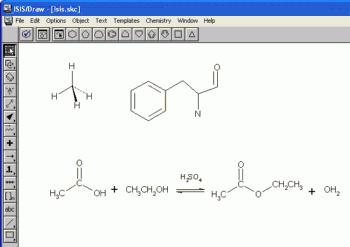


نرم افزاری برای رسم ساختار مولکول (isis draw)

یکی از معروف ترین و پر کاربرد ترین نرم افزار ها در زمینه رسم ساختار های شیمیایی می باشد. شما با استفاده از این نرم افزار می توانید پیچیده ترین ساختار های شیمیایی را به راحتی رسم نموده و ساختار حاصل را در نرم افزار هایی مانند word وpowerpoint وارد نمایید.

شکل زیر محیط کلی نرم افزار را نشان می دهد:


دانلود کتابهای پلیمر

Processing Thermoplastics

Processing Thermoplastics

Blown Film

Overview:
The process involves extrusion of a plastic through a circular die, followed by "bubble-like" expansion.

Typical Materials Used:

Mainly Polyethylenes (HDPE, LDPE and LLDPE) but a wide variety of other materials can be used as blends with these resins or as single layers in a multi-layer film structure. these include PP, PA and EVOH

Typical Products Produced:

Industry packaging (e.g. shrink film, stretch film, bag film or container liners), Consumer packaging (e.g. packaging film for frozen products, shrink film for transport packaging, food wrap film, packaging bags, or form, fill and seal packaging film), Laminating film (e.g. laminating of aluminium or paper used for packaging for example milk or coffee), Barrier film, films for the packaging of medical products, Agricultural film (e.g. greenhouse film, crop forcing film, silage film, silage stretch film).
blown film process

Extrusion Blow Moulding

Overview:The blow moulding machine is based on a standard extruder barrel and screw assembly to plasticise the polymer. The molten polymer is led through a right angle and through a die to emerge as a hollow (usually circular) pipe section called a parison.

Typical Materials Used:

Polypropylene (PP), Polyethylene (PE), Polyethylene - Terephthalate (PET) and Polyvinyl chloride (PVC) 


Typical Products Produced:

Bottles and containers, Automotive fuel tanks, Venting ducts, Watering cans and Boat fenders etc


click here to view a large flash image

Extrusion Profiles & Sheet

Overview
Along with Injection moulding, Pro-file Extrusion of plastics materials is a widely used method of forming plastics materials. The Plastic raw material is both melted and trav-ersed along by the action of heated rotary screws. It is a continuous process and is thus able to manu-facture long lengths of a product. This is ideal for such applications as pipes and gaskets.  However very often the continuous extrusion is cut into application lengths

Typical Materials Used:
HDPE, PVC and and PTFE filled PVC

Typical Products Produced:
Land Drainage Tubing, Animal Feeding Troughs, Cable Harness, Door Seals, Light Diffusers, Electrical Conduit and Cable Protector, Rainwater Pipes and Guttering, Facia & Soffit Sections, Curtain Track, Fridge Seals, Edge Trim, Caravan Window Surrounds, Garden Fence Posts & Decking, Blood Drip Tubes & Catheter Tubes, Dip Tubes, Gas Pipes, Water Pipes, Soil Pipes and Window, Door and Conservatory Sections


extrusion profiles and sheet


plastics sponsorship available

Injection Blow Moulding

Overview
Injection blow moulding is used for the Production of hollow objects in large quantities. The main applications are bottles, jars and other containers. The Injection blow moulding process produces bottles of superior visual and dimensional quality compared to extrusion blow moulding. The process is ideal for both narrow and wide-mouthed containers and produces them fully finished with no flash.

Typical Materials Used:
Polyethylene (Low Density) LDPE, (LLDPE), Polypropylene (PP), Polyethylene - Terephthalate (PET), Polyvinyl chloride (PVC), Polyethylene (High Density) HDPE)

Typical Products Produced:
Plastic Bottles


click here to view a large flash image
 

Injection Moulding

Overview
Injection Moulding (or Molding to use the US spelling), along with extrusion ranks as one of the prime processes for producing plastics articles. It is a fast process and is used to produce large numbers of identical items from high precision engineering components to disposable consumer goods.

Typical Materials Used:
Acrylonitrile-Butadiene-Styrene (ABS), Nylon (PA), Polycarbonate (PC),  Polypropylene (PP) and Polystyrene (GPPS)

Typical Products Produced:
Power-tool housing, Telephone handsets, Television Cabinets, Electrical Switches, DVDs, Automotive bumpers, Automotive dash boards, Battery Casings, Syringes, Drug Inhalation Units, Disposable razors,  washing-up bowls, Wheelie bins, Crates/Recycling boxes and Bottle Lids/closures


click here to view the animation

Injection Moulding (Gas Assisted)

Overview
Developments over the past years in Gas Assisted Moulding or (Gas Assisted Molding to use the US spelling or Gas Injection Moulding being a common reference term) have resulted in advances in the way in which injection moulded components are manufactured. Enhanced quality, reduced cycle times and component weight reductions can be achieved by the process.

Typical Materials Used:
Acrylonitrile-Butadiene-Styrene

Typical Products Produced:
Power-tool housing, Telephone
 

click here to view a large flash image.
sponsored by:
cinpres gas injection logo
 

Injection Stretch Blow Moulding

Overview
Injection stretch blow moulding is used for the production of high quality containers.

Typical Materials Used:
Polyethylene - Terephthalate (PET)

Typical Products Produced:
Carbonated and soft drink bottles, Cooking oil containers, Agrochemical containers Health and oral hygiene products and Bathroom and toiletry products


click here to view a large flash image 

Insert Moulding 

Overview
Inserts can either be incorporated at the time of the moulding process, or be inserted as a post moulding operation. When incorporated as part of the moulding process, the inserts can either be loaded by robot assistance or by the process operator. If the inserts are applied as a post moulding operation, they can usually be applied any time after the moulding process. In some cases, they are inserted as part of a series of post moulding operations. This helping to minimize the actual cost of insertion. The fundamentals of process speed (and economics), and process repetition must be borne in mind when making the decision when to apply the insert. It is not good practice to allow the cycle time to vary from shot to shot; this can have an adverse effect on the quality


click here to view a large flash image
sponsored by:
mckechnie logo 

Machining of Plastics

 Where a plastics component is specified and the numbers to be used are not large, then machining the component becomes more economical.

Moulding Expanded Polypropylene (EPP)

Overview
EPP is a highly versatile closed-cell bead foam that provides a unique range of properties, including outstanding energy absorption, multiple impact resistance, thermal insulation, buoyancy, water and chemical resistance, exceptionally high strength to weight ratio and 100% recyclability. EPP can be made in a wide range of densities, from 15 to 200 grams per litre, which are transformed by moulding into densities ranging from 18 to 260 grams per litre. Individual beads are fused into final product form by the steamchest moulding process resulting in a strong and lightweight shape.
sponsored by:
arpro logo

Moulding Expanded Polystyrene (EPS)

Overview
Expanded polystyrene (EPS) is used for the production of a number of applications. However its major application is as a protective packaging for consumer electronic products and white goods. Its excellent thermal insulation and mechanical protection properties make it ideal to package fish and other foodstuffs. EPS also has applications in horticulture as seed trays. The outstanding shock absorbency of expanded polystyrene packaging ensures the protection of a broad range of products.

EPS Process 
click here to view a large flash image
sponsored by:
economy performance sustainability

Process Cooling

Overview
The necessity to cool or chill plastics processing machinery is mainly related to thermoplastic materials. At room temperature thermoplastic materials (polypropylene, nylon and PET etc) are solid. In order to shape them they must first be heated to their molten temperature. When molten, they can then be manipulated (injection moulded, extruded etc) to a new shape. When formed to their new shape they must then be cooled to solidify them. Considerable amounts of heat energy have to be extracted from the material, the tooling and the machinery that is doing the forming.


click here to view a large flash image  
sponsored by:
aqua cooling logo

Rotational Moulding

Overview
Rotational moulding (often referred to as Rotamoulding or Rotomoulding) is a process used for producing hollow plastic products. By using additional post-moulding operations, complex components can be produced enabling the process to compete effectively with other moulding and extrusion practices.

Rotational moulding differs from other processing methods in that the heating, melting, shaping, and cooling stages all occur after the polymer is placed in the mould, therefore no external pressure is applied during forming.

This provides the following advantages Economically produced large products, Minimum design constraints, Stress-free products, No polymer weld lines and Comparatively low mould costs.


click here to view a large flash image
sponsored by:
balmoral logo

Structural Foam

Overview
Structural Foam is a term commonly used to describe thermoplastic injection moulding components made by the injection moulding process which have a cellular core. A cellular plastic is one in which the outer surface is denser than the inner layers. The core of the moulding is of a honeycomb nature and less dense than the outer surface. The combination results in a moulding of a high stiffness ratio compared with non-structural foam (compact) mouldings.


Structural Foam Process

click here to view a large flash image
sponsored by:
hallam plastics limited logo

Thermoforming

Overview
Thermoforming has close similarities with Vacuum Forming except that greater use is made of air pressure and plug assisted forming of the softened sheet. The process is invariably automated and faster cycle times are achieved than in the Vacuum Forming process. Only thermoplastics sheet can be processed by this method.


click here to view a large flash image 

Vacuum Forming

Overview
Thermoforming is one of the oldest and most common methods of processing plastic materials. Vacuum formed products are all around us and play a major part in our daily lives. The process involves heating a plastic sheet until soft and then draping it over a mould. A vacuum is applied sucking the sheet into the mould. The sheet is then ejected from the mould. In its advanced form, the vacuum forming process utilizes sophisticated pneumatic, hydraulic and heat controls thus enabling higher production speeds and more detailed vacuum formed applications.


click here to view a large flash image
sponsored by:
formech vacuum forming machines logo

Other Extrusion Processes

EXTRUSION OF CAST FILM
DESCRIPTION
From a silt die melt is fed onto a roll or band to produce thin film.

NOTABLE POINTS 
High gloss finish on very thin film.

CALENDERING OF THIN SHEET/FILM
DESCRIPTION
Production of precision thin sheet/film by passing through a series of rolls.

APPLICATIONS
Decorative sheet for flooring. Protective sheet. Stretch wrap film.

NOTABLE POINTS
Exclusively for long runs.

COEXTRUSION/LAMINATING
DESCRIPTION
Production of sheet with layers of different materials.

APPLICATIONS
Packaging, refrigerator door liners, outdoor applications.
 
NOTABLE POINTS
Sheet has improved balance of properties.


plastics sponsorship available
 

Processing Thermosets

Pultrusion 

 OverviewThe Pultrusion process starts by pulling/drawing continuous reinforcements (in rovings or mat / roving forms) through a resin impregnation system. Each fibre is coated with a specially formulated resin; the process is controlled to ensure full “wetting out” of the fibre reinforcement. Excess resin is then removed to expel any trapped air and to compact the fibres.

The coated fibres are passed through preforming guides to align reinforcement and preform the part to the desired shape before entering the heated die. The shape and dimensions of the end product are ultimately determined by the die cross section. The temperature of the die is carefully controlled to ensure that the composite is fully cured, the rate of reaction is controlled by heating and cooling zones in the die.


Click Here to view a large Flash Image


Resin Transfer Moulding

Overview
RTM is a low pressure moulding process, where a mixed resin and catalyst are injected into a closed mould containing a fibre pack or preform. When the resin has cured the mould can be opened and the finished component removed.

A wide range of resin systems can be used including polyester, vinylester, epoxy, phenolic and methyl methacylates etc, combined with pigments and fillers including aluminium trihydrates and calcium carbonates if required.

The fibre pack can be either, glass, carbon, arimid, or a combination of these. There are a large variety of weights and styles commonly available.
resin transfer moulding process

SMC / DMC Moulding

Overview
How The Materials Are Made DMC & BMC
Manufactures of DMC/BMC compounds is a batch process. The ingredients, chopped glass fibres, resin, mineral fillers, catalysts and a mould release      DMC Conduit Box agent are loaded into a special mixer. Output from the mixer is in a flock form which is subsequently extruded in a rope type extrusion.

SMC
Manufacture of SMC is a continuous in-line process. The material is sheathed both top and bottom with a plastic film. A Paste is prepared comprising resin, styrene, heat activating catalysts, inert fillers, release agents and thickeners. The paste is spread uniformly onto an SMC Junction Box the bottom film. Chopped glass fibres are randomly deposited onto the paste. The top film is introduced and the sandwich is rolled into a pre-determined thickness. The sheet is allowed to mature for 48 hours.


Click Here to view a large flash file
 

Other GRP Moulding Techniques

(click here for more information)
HAND LAY-UP/SPRAY LAY UP
Usually involves impregnation of glass fibre mat with a liquid polyester mix. Hand Lay-up is a method of producing composite structures by hand applying composite materials in successive layers on a tool or mould that defines the part geometry. Spray lay up is essentially a variant on this process that involves spraying the matetial into the mould.  A 'Gel Coat' can be incorporated provides a good surface on the mould side.

COMPRESSION MOULDING
Compression Moulding is perhaps the next most common technique for moulding thermosets.  Compound or blend is placed in mould and heated under pressure within the platens of a steam-heated press. When reaction is complete, product is cooled and ejected.  Compression moulding is a batch, as opposed to continuous process. Press moulding Material is charged to a large press with flat platens, generally in the form of a 'pre-preg'. Heat and pressure are applied to react the mixture and convert it into the finished product. This technique is used for large mouldings and some sheet products.  As with compression moulding, this is a rather slow process.

RESIN TRANSFER MOULDING

The molten resin is transferred by pressure from a meltpot into a mould, which is at a temperature above the meltpoint of the resin. This higher temperature is important for the filling of moulds with high flow length, high wall thickness ratios and to allow for shrinkage compensation.

PULTRUSION
Pultrusion is a continuous process for manufacturing composites in rods, tubes and structural shapes having constant cross sections. After the reinforcement is passed through the resin-impregnation bath, it is drawn through a shaping die to form the desired cross section ; curing takes place before the laminate can depart from the cross section.

FILAMENT WINDING
Is a continuous, automated fabrication method that can be highly automated and repeatable with relatively low material costs. A long, cylindrical tool called a mandrel is suspended horizontally between end supports, while the "head" - the fibre application instrument - moves back and forth along the length of the mandrel as it rotates on the horizontal axis, placing fibre onto the tool in a predetermined configuration. In most applications, the filament winding apparatus passes the fibre material through a resin "bath," just before the material touches the mandrel. This is called "wet winding." Towpreg - continuous fiber pre-impregnated with resin - also can be wound, eliminating the need for an on-site resin bath. In a slightly different process, fiber is wound without resin ("dry winding"). The dry shape is then removed and used as a preform in another moulding process, such as resin transfer molding (RTM).

REACTION INJECTION MOULDING
These procedures produce polymers made by reaction during moulding such as polyamides (thermoplastics) or polyurethanes, unsaturated polyesters, epoxies and phenolics (thermosets). RIM can be done using injection or transfer moulding. 

INJECTION MOULDING
Injection Moulding of thermosets Basically this is the same process as used for thermoplastics, modified to avoid hardening of the plastic in the machine. The materials used are widely known as Dough or Bulk Moulding Compounds (DMC or BMC). In sheet form they are known as Sheet Moulding Compound (SMC) Applications include electrical switch and fuse boxes, domestic electrical equipment, microwave containers and tableware. It is also used for business machine housings, gas and electricity meter housing and dish aerials.


plastics sponsorship available

Secondary Processing / Finishing

Welding

Overview
Plastic products cannot always be made in one piece. Design and tooling constraints sometimes make it more economical and/or advantageous to tool the product as two or more pieces. Post moulding joining of the parts provides a means of achieving an end solution  Which Method? The choice of which method of joining ultimately depends on the parts material, geometry and size, process capability, volume and cycle time desired. Other considerations such as capital costs will have a bearing on the choice.

Applications:
Design and tooling constraints sometimes make it more economical and/or advantageous to tool the product as two or more pieces. Post moulding joining of the parts provides a means of achieving an end solution.
sponsored by:
branson logo

Thermoplastic Fabrication

Overview
The Industrial Fabrication process of Thermoplastics is a secondary manufacturing process which can be defined as the use and further modification of primary manufactured sheet, pipe, lining and moulded or formed profiles using compatible materials and welding methods to produce a final product or system which can be used in conjunction with or in isolation from non-thermoplastic materials in the provision of a service, facility, system or process in a diverse range of Industrial applications.
plastics sponsorship available

Recycling

Overview
All plastics can be recycled however the extent to which they are recycled depends upon both economic and logistic factors. As a valuable and finite resource, the optimum use for most plastic after its first use, is to be recycled, preferably into a product that can be recycled again. The UK uses over 5 million tonnes of plastic each year of which an estimated 19% is currently being recovered or recycled. This figure is expected to increase significantly to over 25% of the all plastics consumed in the UK by 2010.

Applications:All plastics can be recycled. The extent to which they are recycled depends upon both economic and logistic factors


5) Static Control Problems in the Plastics Industry

Problems with static electricity in the plastics industries are numerous.  Processes where static charge can be an issue include injection moulding, blow moulding, thermoforming, rotational moulding, parts conveying and collection and assembly processes.

The primary problems resulting from high levels of static charge are:

  • Dust  Attraction & Contamination
  • Process Control & Quality Problems
  • Operator Shocks
sponsored by:
meech sponsorship available


6) Process Costing Guide

 
process costing guide

Note 

1. Rotational moulding using very simple equipment 
2. Rotational moulding using sophisticated equipment


Plastics Processes

Content

1) Processing Thermoplastics
1.1 Blown Film
1.2 Extrusion Blow Moulding
1.3 Extrusion Profiles & Sheet
1.4 Injection Blow Moulding
1.5 Injection Moulding
1.6 Injection Moulding (Gas Assisted)1.7 Injection Stretch Blow Moulding
1.8 Insert Moulding
1.9 Machining of Plastics
1.10 Moulding Expanded Polypropylene (EPP)
1.11 Moulding Expanded Polystyrene (EPS)
1.12 Process Cooling
1.13 Rotational Moulding
1.14 Structural Foam
1.15 Thermoforming
1.16 Vacuum Forming

1.17 Other Extrusion Processes
2) Processing Thermosets
2.1 Pultrusion
2.2 Resin Transfer Moulding
2.3 SMC / DMC Moulding
2.4 Other GRP Moulding Techniques

3) Secondary Manufacturing Processes 

3.1 Welding
3.2 Thermoplastic Fabrication


4) Recycling

5) Static Control Problems in the Plastics Industry
6) Process Costing Guide

Introduction to Photoelasticity

Examination of a Manufactured Article

The Stiffness of Rubber

The Glass Transition in Polymers

Crystallinity in polymers

Crystallinity in polymers

POLYMER  structure


    polymerbasics

    بازخوانی اهداف ضد جمعیتی ممنوعیت استفاده از DDT

    DDT چه نوع ماده ای است؟ آیا استفاده از آن برای سلامت انسان مضر است یا نه؟ دلیل اصرار شدید نهادها و سازمانهای غربی برای حذف DTT از رده آفت کش ها چه بود؟ DDT چه ازتباطی با مبحث کنترل جمعیت دارد؟ با گزارش ویژه مشرق همراه باشید تا به ارزش جان انسان ها نزد سیاستمداران غربی پی ببرید.


    گروه گزارش ویژه مشرق؛ تاملی کوتاه در آنچه که در بیست و چهارم سپتامبر 1944 از زبان یگانه مکار سیاست انگلستان، وینستون چرچیل جاری شده است کافیست تا ما را به مروری بر صفحه های سیاهی از تاریخ در مورد ماده DDT وا دارد: 

    چرچیل می گوید: «ما عوامل پیشگیری فراوانی علیه بیماری های گرمسیری و حمله تمامی انواع حشرات از شپش گرفته تا پشه ها و عقب راندن آن ها کشف کرده ایم. DDT پودر فوق العاده ای است که کاملا بررسی و آزمایش شده و نشان داده شده است که نتایج اعجاب انگیزی دارد و بعد از این در حجم های عمده توسط نیروهای بریتانیایی در برمه و نیروهای آمریکایی و استرالیایی در اقیانوسیه و هند در تمامی مناطق استفاده خواهد شد». در این گزارش به اهداف پشت پرده جمعیت زدایی با اعلام ممنوعیت استفاده از DDT خواهیم پرداخت. 

    چرچیل اولین سیاست مداری بود که در مورد اهمیت DDT صحبت کرد. 

    DDT آفت کشی بود که برای اولین بار در سال 1874 ساخته شد ولی با توجه به عدم شناسایی کامل ساختار و فعالیت آن تا سال 1930 توجهی به آن نشد. در اواخر دهه سی میلادی، پائول موللر (Paul H. Müller) قابلیت DDT برای کشتن حشرات موذی را معرفی کرد. با توجه به اثرات اعجاب انگیز این ماده در کاهش مرگ و میر انسان ها و نیز افزایش تولیدات کشاورزی، موللر در سال 1948 جایزه نوبل پزشکی را برنده شد. ویکتور فرولیشر (Victor Froelicher) که با کارهای موللر آشنا بود؛ در اکتبر 1942، DDT را به اداره تحقیقات و توسعه علمی ارتش آمریکا معرفی کرد. با بررسی کارهای موللر، کارشناسان ارتش آمریکا با زیرکی تمام به اهمیت فوق العاده DDT پی بردند.


    پائول موللر به دلیل تحقیقاتش بر روی DDT جایزه نوبل گرفت.


    ویکتور فرولیشر اطلاعات DDT را به ارتش آمریکا انتقال داد.

     در آن دوران بیماری مالاریا نیروهای دریایی آمریکا را که درگیر کشمکش با نیروی دریایی ژاپن بودند از پا انداخته بود. بلافاصله ارتش وارد مذاکره با کارخانه های سم سازی شد تا DDT را به صورت انبوه تولید کرده و از آن برای مقابله با گسترش بیماری مالاریا بین تفنگداران دریایی آمریکا استفاده کند. به علاوه ارتش آمریکا از DDT برای ضد عفونی کردن تمامی مناطق جنگی پس گرفته شده از آلمانی ها نیز استفاده کرد. برای مثال پس از عقب نشینی ارتش آلمان از ایتالیا، نیروهای آمریکایی با استفاده از DDT بیماری های واگیردار قابل انتقال با حشرات و جوندگان را در شهرهای این کشور کنترل کردند و توانستند از مرگ و میر افراد غیر نظامی فراوانی جلوگیری کنند.


    ارتش آمریکا به سرعت متوجه قابلیت DDT در جبهه های جنگ شد.    
                  
    در اواخر جنگ جهانی دوم این ماده فقط در مناطق جنگی کاربرد داشت؛ اما با پایان یافتن جنگ و با توجه به کارایی فوق العاده آن، DDT در اختیار آژانس های بهداشت عمومی سراسر جهان قرار گرفت. از آنجا که درصد بالایی از بیماری های عفونی شناخته شده انسان توسط حشرات منتقل می شد؛ استفاده از DDT برای کشتن حشرات امری معقول به نظر می رسید. هم چنین حشرات، موجب از بین رفتن محصولات کشاورزی و قحطی و گرسنگی هم می شدند. به همین دلیل DDT به عنوان یک ناجی بزرگ مطرح شد که علاوه بر جلوگیری از کشتار انسان ها توسط عوامل بیماری زا به افزایش تولید غذا نیز کمک می کرد.


    در اواخر جنگ دوم جهانی از DDT برای مبارزه با بیماری ها در مناطق جنگ زده استفاده شد.

     آمریکا از اولین کشورهایی بود که از  DDT  در اهداف غیر نظامی بهره برد. از سال 1946 سازمان بهداشت عمومی آمریکا از DDT برای مبارزه با مالاریا استفاده کرد. پروژه موفقیت آمیز بود تا جایی که در سال 1952 فقط دو مورد از ابتلا به مالاریا از سراسر آمریکا گزارش شد. کشورهای دیگر به سرعت از آمریکا الگوبرداری کرده و به استفاده گسترده از DDT روی آوردند. کارخانه های بزرگی برای تولید آن ساخته شد و کشورهای جهان سوم با توجه به قیمت ارزان آن به راحتی می توانستند آن را خریده و استفاده کنند. 


    پس ازجنگ استفاده غیر نظامی از DDT شروع شد.

    در نیمه دهه 50 مالاریا در اروپا ریشه کن شد و تعداد مبتلایان به مالاریا در آفریقای جنوبی 80 درصد کاهش یافت. در سال 1946 حدود 2 میلیون و 800 هزار نفر در سریلانکا مبتلا به مالاریا بودند که با استفاده از DDT این تعداد در سال 1963 به رقم اعجاب انگیز 17 نفر رسید. DDT مرگ و میر مالاریا در هند را نیز به صفر رساند. در کل DDT توانست ابتلا به مالاریا را در آسیا و آمریکای لاتین 99 درصد کاهش دهد.


    DDT توانست مرگ و میر ناشی از بیماری های منتقله با حشرات را به شدت کاهش دهد. 

     با این حال نگاه به DDT با ظهور مشکوک راشل کارسون (Rachel Carson) و نوشته هایش که سرتاسر سوء استفاده از علم و علمی جلوه دادن یک سری فرضیات بود؛ راه دیگری در پیش گرفت. در سال 1958 ویراستار یک مجله آمریکایی از راشل خواست که به عنوان یک زیست شناس مطالبی را در مورد حمایت از طبیعت و مضرات استفاده از DDT بنویسد. راشل شروع به نوشتن سلسه خذعبلاتی کرد که در سال 1962 به صورت کتابی با نام بهار خاموش به چاپ رسید. راشل در این کتاب با آب و تاب فراوان از شهری سخن می گوید که مردم آن مسموم شده اند و بهار در آنجا خاموش است زیرا تمامی پرندگان به دلیل استفاده از حشره کش هایی مانند DDT مرده اند!  


    اعلام خطر و دروغ پردازی علیه DDT توسط راشل کارسون و دست های پشت پرده هدایت کننده او شروع شد.

    این کتاب از بنیه علمی برخوردار نبود و اطلاعات غلط و بی پایه ای در مورد انقراض جانداران در اثر استفاده از DDT ارائه می داد و ادعا می کرد این ماده سرطان زا است؛ موضوعی که هیچ گاه به اثبات نرسید. وحشت انتشار داده شده توسط این کتاب و مانور رسانه ای قوی پشتیبانی کننده آن ترس از DDT را به خارج از مرزهای آمریکا کشاند. طبق هشدارهای کارسون برخی دولت ها استفاده از DDT را برای مبارزه با مالاریا ممنوع اعلام کردند. نتایج وحشتناک بود.


    هجمه رسانه ای شدیدی علیه DDT به راه افتاد.

     برای مثال در سیرالئون که در سال 1963 فقط 17 مورد مرگ در اثر مالاریا گزارش شده بود؛ ممنوعیت استفاده از DDT در سال 1964، به  مرگ و میری در حد سالانه نیم میلیون نفر انجامید. در برخی کشورها نتایج اسفناک تر هم بود. با این حال دست های پر قدرتی وجود داشت که به تبلیغ خطرناک بودن DDT برای محیط زیست می پرداخت و سعی می کرد استفاده از این ماده را که به افزایش تولیدات کشاورزی و کاهش مرگ و میر انسانی منجر می شد وحشتناک و مدهش نشان دهد.


    در کشورهای جهان سوم با ممنوعیت استفاده از DDT بیماری و مرگ و میر دوباره بازگشت.

     در سال 1970 گزارش بسیار قابل توجهی از سوی آکادمی ملی علوم در آمریکا منتشر شد که در آن آمده است: «استفاده از DDT موجب افزایش بالای تولیدات کشاورزی شده و انسان های بی شماری را از بیماری هایی خطرناکی ماند تیفوس و مالاریا نجات داده است. در حقیقت، تخمین زده می شود که در کمی بیش از دو دهه آینده DDT از مرگ و میر حدود 500 میلیون نفر که ممکن بود در اثر مالاریا بمیرند جلوگیری کند.


    DDT توانسته بود تولید محصولات دامی و کشاورزی را در کشورهای جهان سوم بالا ببرد. 

     ممنوعیت استفاده از این ماده مفید تنها در صورتی معقول خواهد بود که ثابت شود استفاده از آن نتیجه ای برای پیشرفت بشر در بر ندارد. تمامی موادی که به عنوان جایگزین برای DDT در نظر گرفته شده هم گران قیمت هستند و هم خطر بسیار بیشتری از آن برای انسان و طبیعت دارند». 
    علی رغم تاییدات این مرکز علمی کسانی که به ظاهر از حفاظت از محیط زیست دم می زدند بر ممنوعیت استفاده از DDT پافشاری کردند. 

    در میان این افراد اشخاصی همچون پائول ارلیش وجود داشت که کتاب "بمب جمعیت" او برای مدیران برنامه های مبارزه با افزایش جمعیت کره زمین مقدس محسوب می شود. با این حال روز به روز بر شدت تبلیغات علیه DDT افزوده می شد و همکاری کاملا مشکوکی بین رسانه ها، مدعیان حفاظت از محیط زیست و طرفداران کاهش جمعیت زمین به وجود آمده بود. 

    کارشناسان آژانس حفاظت از محیط زیست آمریکا وارد میدان شده و طی یک تحقیقی که 7 ماه به طول انجامید با به کارگیری 125 کارشناس به بررسی ادعاهای مطرح شده پرداخت. در گزارش این تحقیق آمده است: «استفاده از DDT با شرایط و دستور مصرفی که فعلا وجود دارد بر روی آب های شیرین، ماهی ها، موجودات زنده آبگیرها، پرنده های وحشی یا دیگر جانوران وحشی هیچ گونه تاثیر ناگواری ندارد.  DDT سرطان زا نبوده و در انسان موجب جهش ژنتیکی یا ناهنجاری جنین نمی شود». اما رییس آژانس توجهی به نتایج این تحقیق نشان نداد. 

    ویلیام راکلشاس (William D. Ruckelshaus) که ریاست آژانش را به عهده داشت حتی حاضر نشد جلسه ای یک ساعته با تیم تحقیقاتی برگزار کند و بالاخره بدون خواندن گزارش تحقیق، در سال 1972 استفاده از DDT را در آمریکا ممنوع اعلام کرد. 
     

    راکلشاس در کنار جانسون که آغاز کننده برنامه کنترل جمعیت در جهان بود.        

    اما پشت پرده ماجرا آنجا رخ می نماید که می بینیم آژانس توسعه بین المللی آمریکا که در آن سال ها سخت درگیر برنامه های کاهش جمعیت در سراسر جهان بود نیز وارد بحث استفاده از DDT شده است. پس از اعلام ممنوعیت استفاده از DDT در آمریکا، این آژانس جهانی سازی این تصمیم را به عهده گرفته و اعلام کرد از پروژه های بین المللی که به هر نحوی با استفاده از DDT در ارتباط باشند حمایت نخواهد کرد. 
    همچنین به کشورهای جهان سوم اعلام شد که اگر خواستار کمک های آژانس توسعه بین المللی آمریکا یا سایر کمک ها مالی بین المللی هستند باید استفاده از DDT و مبارزه علیه مالاریا را متوقف کنند. این خواسته آژانس دقیقا مشابه خواسته دیگر او بود که در مرود جمعیت مطرح شد.


    بیماری و مرگ و آفریقا و شبه قاره بازگشت.

     آژانس در محدودیت تحمیلی دیگری اعطای هرگونه کمک های مالی به کشورهای جهان سوم را منوط به اجرای برنامه های کاهش جمعیت توسط دولت این کشورها کرده بود. حتی اگر کشوری این شرط را نمی پذیرفت باز دچار مشکل می شد. 

    زیرا که صادرات DDT از آمریکا ممنوع شده بود و دیگر بهای آن در حدی نبود که کشورهای فقیر قادر به تهیه آن باشند. در نتیجه راهی به جز گردن نهادن به خواسته های آژانس نداشتند که ماموریت نخست آن در آن زمان کاهش رشد جمعیت جهان به خصوص در کشورهای فقیر آسیایی، آفریقایی و آمریکای جنوبی بود. 

    در نتیجه بیماری های منتقله توسط حشرات دوباره شیوع یافت. تخمین زده می شود مرگ و میر ناشی از مالاریا در آفریقا که در صورت استفاده از DDT جلوی آن گرفته می شد؛ به 100 میلیون نفر می رسد. الکساندر کینگ که از بنیان گذاران کلوب روم است در سال 1990 گفته است: «هنگامی که DDT برای مصارف غیرنظامی مطرح شد من به ماجرا شک کردم. در کشور گویان در طی دو سال DDT مالاریا را از بین برده است اما در همان دوره نرخ زاد و ولد دو برابر شده است. بنابراین نارضایتی اصلی من از نتایج استفاده از DDT این است که این ماده مشکل جمعیت را شدیدا افزایش داده است».


    بنیان گذار کلوب روم:
     مشکل استفاده از DDT افزایش جمعیت ناشی از آن است!

    براین اساس، در یک رویکرد کاملا ظالمانه برنامه ریزان کاهش جمعیت جهانی از به کارگیری یک یافته علمی نجات بخش که می توانست به کاهش مرگ و میر انسان ها کمک کند جلوگیری کردند. چنان که ذکر شد در سال 1970 آکادمی ملی علوم آمریکا اعلام کرد «در کم تر از دو دهه آیندهDDT  از مرگ 500 میلیون انسان در اثر بیماری مالاریا جلوگیری خواهد کرد». 

    این خبر به مذاق مدافعان کنترل جمعیت جهان خوش نیامد و بلافاصله پس از یک عملیات رسانه ای وسیع استفاده از این ماده را غیر قانونی اعلام کردند. تا سال 1970 تمامی منابع علمی معتبر بر کارایی و همچنین بی خطر بودنDDT  برای انسان و جانوران اذعان داشتند و حتی هم اکنون نیز مدارک علمی معتبری برای اثبات مضر بودن DDT در دسترس نیست.


    مدافعان، DDT را به عنوان سلاحی برای نجات دسته جمعی در برابر کشتار دسته جمعی می دانستند.

    در واقع این ماده سالم ترین و ارزان ترین نوع از مواد شناخته شده برای مبارزه با مالاریا بود. در نتیجه جهان سوم به راحتی می توانست به آن دست پیدا کرده و بیماری های حاصل از حشرات ناقل را کنترل کند. این اتفاق برای برنامه های کنترل جمعیت جهان به هیچ وجه خوشایند نبود و به بهانه خطرناک بودن این ماده برای محیط زیست استفاده از آن را ممنوع اعلام کردند و داستان هایی ساختند که مثلا می گفتDDT  باعث نازک شدن پوسته تخم پرندگان و در نتیجه بر هم خوردن تعادل طبیعت می شود و یا از طریق نفوذ در خون سلامتی انسان را تهدید می کند.

    گزارش های فراوانی وجود دارد که بر ساختگی بودن همه این ادعاها و سوء استفاده از موضوعات علمی اشاره دارند. هدف از این کار جلوگیری از کاهش مرک و میر مردم کشورهای فقیر بوده است. مردمی که به زعم بنیان گذاران نظم نوین جهانی در برنامه های آینده جهان جایی ندارند و باید به روش های مختلف از روی زمین محو شوند.


    بیماری و مرگ آفریقا را از پای انداخته است.
     راشل اشتباه کرده بود!

    ..........................................................................................

    منابع و مآخذ:


    http://online.wsj.com/article/SB10001424052748703876404575200420877856064.html

    http://www.thenewatlantis.com/publications/the-truth-about-ddt-and-silent-spring

    http://www.nobelprize.org/nobel_prizes/medicine/laureates/1948/press.html

    http://www.sciencemag.org/content/176/4039/1153

    http://www.aei.org/article/energy-and-the-environment/the-rise-fall-rise-and-imminent-fall-of-ddt/

    www.jpands.org/vol9no3/edwards.pdf

    http://www.nap.edu/openbook.php?record_id=9575&page=R1

    www.thenewatlantis.com/docLib/20120926_SweeneyDDTdecision.pdf

    www.epa.gov/history/topics/ddt/DDT-Ruckelshaus.pdf

    http://transition.usaid.gov/our_work/environment/compliance/22cfr216.htm

    http://transition.usaid.gov/our_work/global_health/id/malaria/news/afrmal_ddt.html

    http://www.nytimes.com/2004/04/11/magazine/what-the-world-needs-now-is-ddt.html?pagewanted=all&src=pm

    www.atsdr.cdc.gov/toxprofiles/tp35.pdf

    http://wwwnc.cdc.gov/eid/article/4/3/98-0313_article.htm

    http://archive.org/stream/pesticidesmonito05unit#page/330/mode/2up
    http://www.sciencemag.org/content/159/3822/1474

    http://www.jstor.org/discover/10.2307/3454288?uid=3739560&uid=2&uid=4&uid=3739256&sid=21101644948847

    http://www.tandfonline.com/doi/abs/10.1080/00039899709602202

    http://www.jstor.org/discover/10.2307/27723766?uid=3739560&uid=2&uid=4&uid=3739256&sid=21101644949037

    http://www.sjweh.fi/show_abstract.php?abstract_id=2586

    http://www.ukapologetics.net/populationcontrol.html

    http://www.redstate.com/roetenks/2010/07/17/conceived-overpopulation-problem-reason-for-ddt-downfall/

    http://www.fightingmalaria.org/


    http://www.radioliberty.com/pca.htm

    http://atruthsoldier.wordpress.com/2012/10/15/the-population-control-agenda-of-the-radical-humanists-who-would-love-for-you-and-i-to-die/

    1,1,1-Trichloro-2,2-bis-(4'-chlorophenyl)ethane (DDT) Pathway Map

    1,1,1-Trichloro-2,2-bis-(4'-chlorophenyl)ethane (DDT) Pathway Map

    [Compounds and Reactions] [BBD Main Menu]

    This pathway was contributed by Cynthia Zook, University of Minnesota, and completed by Jingfeng Feng, University of Minnesota.

    1,1,1-Trichloro-2,2-bis-(4'-chlorophenyl)ethane (DDT), the first of the chlorinated organic insecticides, is a widely distributed and persistent xenobiotic contaminant in the environment. DDT is not metabolized very rapidly by animals; instead, it is deposited and stored in the fatty tissues. The biological half-life of DDT is about eight years; that is, it takes about eight years for an animal to metabolize half of the amount it assimilates. If ingestion continues at a steady rate, DDT builds up within the animal over time. Despite being banned in the United States, DDT continues to be widely used in many developing nations. This page shows only its aerobic pathway. The anaerobic degradation of DDT is documented elsewhere in the UM-BBD.

    The chemical structure of DDT, including aromatic and alicyclic moieties, offers a variety of possibilities for biochemical attack. Several aerobic pathways for DDT metabolism in different organisms were suggested (Quensen et al., 1998Hay et al., 1998Nadeau et al., 1994). Compounds in brackets were not identified but postulated based on other studies, such as those of the Biphenyl Pathway.

    The steps labeled A, B, C, D, E are mutiple steps whose intermediates are not identified yet. All descriptions as follows were proposed based on other similar experiments. In A, DDE is attacked by a dioxygenase at theortho and meta positions. Such an attack would give rise to a 2,3-dihydrodiol-DDE intermediate. In B and D, 2-(4'-Chlorophenyl)-3,3-dichloropropenoate may proceed via decarboxylation to yield 1,1-dichloro-(4'-chlorophenyl)ethane. The latter will undergo oxidation of the aliphatic side chain to yield 1,1-dichloro-(4'-chlorophenyl)ethanol which is further oxidized to yield 4-Chloroacetophenone. The terminal methyl group of 1,1-dichloro-(4'-chlorophenyl)ethane may also undergo oxidation to yield phenylacetic acid. In C, the transformation of 4-Chloroacetophenone to 4-Chlorobenzaldehyde may be via complete oxidation and subsequent decarboxylation of the terminal methyl group. In E, the ring-cleavage product would be further degraded to either a C-6- or C-5-chlorinated acid, depending on where the hydrolytic cleavage takes place.

    The following is a text-format DDT pathway map. Organisms which can initiate the pathway are given, but other organisms may also carry out later steps. Follow the links for more information on compounds or reactions. This map is also available in graphic (21K) format.

                 1,1,1-Trichloro-2,2-                        1,1,1-Trichloro-2,2-
                bis(4'-chlorophenyl)ethane                 bis(4'-chlorophenyl)ethane
                          (DDT)                                       (DDT)
                  Microbial Consortium                       Ralstonia eutropha A5
                            |                                           |
                            |           from the                        |
      DDT dehydrochlorinase |  +--- Anaerobic Pathway                   | DDT 2,3-dioxygenase
                            |  |                                        |
                            V  V                                        |
                     1,1-Dichloro-2,2-                                  V
                   bis(4'-chlorophenyl)-                    [cis-2,3-Dihydrodiol DDT]
                      ethylene (DDE)                                    |
                             |                                          |
        Microbial Consortium | Pseudomonas acidovorans M3GY             |
                +------------+------------+                             | cis-2,3-dihydrodiol
       DDE de-  |                         V A                           | DDT dehydrogenase
    halogenase  |                         |                             |
                |                         |                             |
                V                         V                             |
       1-Chloro-2,2-bis-           1,1-Dichloro-2-                      V
      (4'-chlorophenyl)-    (dihydroxy-4'-chlorophenyl)-       [2,3-Dihydroxy DDT]
        ethylene (DDMU)      2-(4-chlorophenyl)ethylene                 |
                |                         |                             |
                |                         | 1,1-dichloro-2-(dihy-       |
                |                         | droxy-4'-chlorophenyl)-     | 2,3-dihydroxy DDT
                |                         | 2-(4'-chlorophenyl)-        | 1,2-dioxygenase
                V                         | ethylene 1,2-dioxygenase    |
             to the                       |                             |
        Anaerobic Pathway                 V                             V
                                  6-Oxo-2-hydroxy-              6-Oxo-2-hydroxy-
                                7-(4'-chlorophenyl)-          7-(4'-chlorophenyl)-
                                3,8,8-trichloroocta-        3,8,8,8-tetrachloroocta-
                                  2Z,4Z,7-trienoate              2Z,4Z-dienoate
                                          |                             |
                                          | 6-oxo-2-hydroxy-7-(4'-      |
                                          | chlorophenyl)-3,8,8-        |
                                          | trichloroocta-2Z,4Z,7-      |
                                          | trienoate hydrolase         |
                                          |                             |
                                          V                             V E
                              2-(4'-Chlorophenyl)-3,3-                  |
                +--------------  dichloropropenoate                     |
                |                         |                             |
                |                         |                             |
                V D                       V B                           |
                |                         |                             V
                |                         |             +---->  4-Chlorobenzoate
                V                         V             |               |
        4-Chlorophenyl-         4-Chloroacetophenone    |               |
             acetate                      |             | 4-chloro-     |
                |                         |             | benzaldehyde  |
                |                         V C           | dehydrogenase |
                |                         |             |               |
                |                         |             |               V
                V                         V             |            to the
              to the             4-Chlorobenzaldehyde --+      2,4-Dichlorobenzoate
        L-Tyrosine Pathway                                           Pathway

    [Compounds and Reactions] [BBD Main Menu]

    Page Author(s): Jingfeng Feng

    April 20, 2012 Contact Us

    © 2013, University of Minnesota. All rights reserved.
    The UM-BBD is licensed to EAWAG for hosting, maintaining and updating.
    
    http://umbbd.ethz.ch/ddt/ddt_map.html
    

    Inorganic Chemistry and Chemical Education

    Tovinhenge: A Little Stonehenge in Laurens click here for the website.

    Tovinhengeowlbookdemo.

    Course Web Pages

    Spring 2013    General Chemistry II, Chem 112

                         Advanced Inorganic Chemistry, Chem 342   

                         Inorganic Chemistry Lab, Chem 242

                         Discussions in Chemistry, Chem 213

    Fall 2012        General Chemistry I, Chem 111

                         Descriptive Inorganic Chemistry, Chem 241


    Other Online Module Links

    Laboratory Technique Videos

    Simulations

                         Multimedia Exploration Modules

                         New Videos

    Current Vita

    Downloads

           Zeolite Explorer by William Vining, Scott Auerbach, Justin Fermann and Amy Roy

           Cyclic Voltammetry Simulator by William Vining, Shaun Sheehan, and Justin Fermann

           Chemland, Version 6.0


    addres:

    http://employees.oneonta.edu/viningwj/


    Laboratory Technique Videos


    Right-Click on each to download onto your computer.

    Then watch using Windows Media Player.


    Using an electronic balance to weigh by difference.


    Using an electronic balance to weight by taring.


    How to use a Bunsen burner.


    How to transfer solids.


    How to transfer liquids.


    How to use a buret.


    How to perform a titration.


    How to perform a gravity filtration.


    How to use a constant-volume pipet.


    How to prepare a solution by direct addition.


    How to prepare a solution by dilution.


    How to use a Spectronic-20 spectrophotometer.


    videos of labratuary

    Some New Videos


    Aluminum + Bromine


    Zinc + Sulfur


    Sugar + H2SO4


    KMnO4 Dissolution


    Cu + HNO3


    Zn + HNO3


    Hot Pt + NH3


    Glowing Pickle


    Nylon


    Zn + Iodine


    Gummi Bear


    Plastic Sulfur


    polymer analysis education swfs

    [DIR] Parent Directory        18-Dec-2010 08:56      -  
    [   ] Barrier_4.swf           22-Jan-2002 16:22    47k  
    [   ] Bonding.swf             22-Jan-2002 16:22   315k  
    [   ] DSC_DTA_V6.swf          28-Jan-2002 08:26   169k  
    [   ] Extruders.swf           22-Jan-2002 16:22   167k  
    [   ] GelVI.swf               22-Jan-2002 16:22    14k  
    [   ] Gelation.swf            22-Jan-2002 16:22    13k  
    [   ] IR.swf                  22-Jan-2002 16:22   245k  
    [   ] IntroWAXS.swf           22-Jan-2002 16:22   366k  
    [   ] MagInterface.swf        22-Jan-2002 16:22    41k  
    [   ] ModvsTemp.swf           22-Jan-2002 16:22    37k  
    [   ] MolWtPropsMI.swf        22-Jan-2002 16:22    36k  
    [   ] OrientWAXS.swf          22-Jan-2002 16:22   176k  
    [   ] Reekie3.swf             06-Jan-2004 09:08   3.2M  
    [   ] Rheology.swf            22-Jan-2002 16:23    71k  
    [   ] RotMold.swf             22-Jan-2002 16:23    83k  
    [   ] Semiconductors.swf      22-Jan-2002 16:23   185k  
    [   ] ShowTell.swf            22-Jan-2002 16:23    81k  
    [   ] SpringDashpot.swf       22-Jan-2002 16:23   101k  
    [   ] StateMatter.swf         22-Jan-2002 16:23   533k  
    [   ] StructMorph.swf         22-Jan-2002 16:23   141k  
    [   ] Superposition.swf       22-Jan-2002 16:23    35k  
    [   ] SynthsMobility.swf      22-Jan-2002 16:23   131k  
    [   ] TA Melting.swf          22-Jan-2002 16:23   126k  
    [   ] TREF.swf                22-Jan-2002 16:23   192k  
    [   ] Tensile3.swf            03-Jul-2002 11:20    18k  
    [   ] TransSpVol.swf          22-Jan-2002 16:23    31k  
    [   ] WAXS_V7.swf             09-Mar-2002 12:34    85k  
    [   ] crystals.swf            22-Jan-2002 16:22    45k  
    [   ] foot.swf                20-May-2002 08:26   142k  
    [   ] peak_widthsV9.swf       22-Jan-2002 16:23    50k  
    [   ] test OK.swf             22-Jan-2002 16:23     2k  
    

    Apache/1.3.41 Server at 


    http://www.personal.psu.edu/irh1/SWF/

    videos of scince

    Name Last modified Size Description


    [DIR] Parent Directory 14-Nov-2010 10:13 - [VID] P2150022.MOV 27-Jul-2010 22:21 11.9M [VID] archaeology.flv 21-Sep-2009 04:12 144M [VID] archaeology_class.flv 03-Mar-2010 18:29 640M [VID] archaeology_summary2..> 19-Feb-2010 23:57 2.1M [VID] bubbles_class.flv 09-Mar-2010 10:50 387M [VID] chemistry_class.flv 25-Jan-2010 09:57 102M [VID] crystal_garden2.flv 09-Jan-2010 15:42 5.2M [VID] density_class.flv 24-Aug-2010 02:31 319M [VID] dinosaurs_class.flv 30-Mar-2010 03:24 530M [VID] dryice2.flv 28-Aug-2009 21:15 71.4M [VID] hydropower.flv 06-Dec-2009 21:46 2.3M [VID] hydropower_class.flv 22-Dec-2009 23:42 503M [VID] hydropower_summary3.flv 23-Dec-2009 09:51 10.0M [VID] mike_meets_maxi.flv 08-Sep-2009 20:42 11.6M [VID] mike_meets_maxi2.flv 06-Sep-2009 07:35 11.5M [VID] ocean_class.flv 14-Sep-2010 23:49 471M [VID] optics_class.flv 19-Jun-2010 19:27 858M [VID] physics_class.flv 24-Aug-2010 13:37 389M [VID] plants.flv 01-Sep-2009 14:00 98.5M [VID] pressure_class.flv 30-Jul-2010 02:45 204M [VID] solarenergy.flv 20-Oct-2009 22:23 6.7M [VID] solarenergy3.flv 22-Oct-2009 08:33 84.8M [VID] space_class_640.flv 16-Nov-2009 19:43 610M [VID] star_trek.flv 13-Dec-2009 00:46 57.1M [VID] time_class.flv 28-Mar-2010 06:02 228M [VID] watersheds_wetlands_..> 11-Mar-2010 00:33 366M


    Constituent Materials Chapters from ASM Handbook

    Index of /~mkessler/MatE454/Constituent Materials Chapters from ASM Handbook

    [ICO]NameLast modifiedSizeDescription

    [DIR]Parent Directory - 
    [   ](1) Review of Carbon Fiber.pdf24-Nov-2003 15:03605K 
    [   ](2) Glass Fibers.pdf08-Oct-2006 13:471.8M 
    [   ](3) Aramid Fibers.pdf08-Oct-2006 13:471.8M 
    [   ](4) Epoxy Resins.pdf08-Oct-2006 13:463.2M 
    [   ](5) Polyester Resins.pdf08-Oct-2006 13:461.6M 
    [   ](6) Bismaleimide Resins.pdf08-Oct-2006 13:442.0M 
    [   ](7) Polyimide Resins.pdf08-Oct-2006 13:453.1M 
    [   ](8) Cyanate Ester Resins - Encyclopedia of coposites.pdf29-Jan-2013 09:461.3M 
    [   ](9) Thermoplastic Resin.pdf08-Oct-2006 13:482.6M 
    [   ](10) Biobased Chapter.pdf22-Feb-2011 11:054.2M 
    [   ](11) Lightweight Structural Cores.pdf08-Oct-2006 13:48861K 
    [   ](12) Interfaces and Interphases.pdf16-Feb-2012 10:554.8M 
    [   ](13) Fabrics and Preforms.pdf16-Feb-2012 11:024.6M 
    [   ]Thumbs.db29-Jan-2013 09:4956K 


    Apache/2.2.15 (Red Hat) Server at home.engineering.iastate.edu Port 80


    http://home.engineering.iastate.edu/~mkessler/MatE454/Constituent%20Materials%20Chapters%20from%20ASM%20Handbook/


    EDUCATION OF SCINSE


    [DIR] Parent Directory 22-Aug-2010 15:03 -
    [   ] Clear_Skin_3.swf 29-Aug-2009 12:46 8k
    [   ] Clock_computer_time_..> 26-Jul-2008 22:30 10k
    [   ] FLVPlayer_Progressiv..> 29-Aug-2009 12:46 9k
    [   ] FuelCellEducation.swf 14-Nov-2010 10:13 146k
    [VID] MAQ00001.MP4 06-Aug-2008 08:40 27.1M
    [VID] MAQ00002.MP4 06-Aug-2008 18:58 25.1M
    [VID] MAQ000020.MP4 27-Jan-2009 20:43 41.4M
    [VID] MAQ00003.MP4 06-Aug-2008 21:13 30.5M
    [VID] MAQ000030.MP4 05-Feb-2009 22:41 38.0M
    [VID] MAQ00004.MP4 09-Aug-2008 12:53 11.1M
    [VID] MAQ00005.MP4 10-Aug-2008 22:26 21.4M
    [VID] MAQ00006.MP4 15-Aug-2008 21:23 26.1M
    [VID] MAQ00007.MP4 21-Sep-2008 11:26 23.2M
    [VID] MAQ00009.MP4 27-Nov-2008 15:58 41.9M
    [VID] MAQ00010.MP4 28-Nov-2008 06:43 38.8M
    [VID] MAQ00011.MP4 15-Dec-2008 19:00 27.2M
    [VID] Magic_Rick_Rios.wmv 13-Sep-2007 21:20 158M
    [VID] OneYearAnniversary.wmv 15-Jul-2007 18:10 82.7M
    [VID] RickRios111307.wmv 14-Nov-2007 08:20 162M
    [   ] Rock_It_logo.swf 27-Aug-2008 22:01 4k
    [   ] Rock_It_logo3.swf 19-Apr-2008 22:05 4k
    [VID] archaeology.mp4 02-Jan-2010 08:16 5.9M
    [VID] boats.wmv 31-May-2009 09:08 450M
    [VID] can_1.wmv 21-Jul-2007 23:20 575k
    [VID] can_2.wmv 21-Jul-2007 23:21 3.0M
    [VID] can_3.wmv 21-Jul-2007 23:27 502k
    [VID] can_4.wmv 21-Jul-2007 23:38 1.3M
    [VID] candle_1.wmv 01-Jul-2007 10:45 2.6M
    [VID] candle_2.wmv 01-Jul-2007 11:09 7.6M
    [VID] candle_3.wmv 01-Jul-2007 11:40 29.6M
    [VID] candle_4.wmv 21-Jul-2007 22:42 1.0M
    [VID] chemistry1-b.wmv 26-Mar-2008 03:01 305M
    [VID] chemistry2.wmv 20-Apr-2008 18:22 118M
    [VID] colors_of_the_sun.wmv 26-Nov-2008 07:19 192M
    [VID] colors_summary.MP4 24-Feb-2009 21:39 45.0M
    [DIR] data/ 04-Dec-2008 22:29 -
    [VID] echoblaster.wmv 17-Dec-2007 21:32 12.5M
    [VID] egg_1.wmv 22-Jul-2007 07:40 1.1M
    [VID] egg_2.wmv 22-Jul-2007 08:02 1.2M
    [VID] egg_3.wmv 22-Jul-2007 08:12 863k
    [VID] egg_4.wmv 22-Jul-2007 08:34 557k
    [VID] electricity.wmv 24-Feb-2008 18:30 138M
    [VID] flower.mov 06-Aug-2008 06:58 2.5M
    [VID] heat_conduction.wmv 01-Jun-2008 19:53 126M
    [VID] hydropower.mp4 28-Dec-2009 14:04 23.3M
    [DIR] images/ 24-Jul-2009 22:33 -
    [VID] intel.wmv 15-Sep-2007 17:34 49.4M
    [VID] lasers_mirrors.wmv 29-Jun-2008 20:40 199M
    [VID] magnetism.wmv 27-Jan-2008 17:26 114M
    [VID] magnetism_summary6.mov 05-Aug-2008 01:11 133M
    [VID] mr_mac_093007-3.wmv 30-Sep-2007 22:19 190M
    [VID] mr_mac_093007.wmv 03-Oct-2007 15:05 187M
    [VID] mrmac.mpg 10-Jun-2007 17:42 18.0M
    [VID] mrmac2.wmv 10-Jun-2007 20:29 649k
    [VID] mrmac3.wmv 10-Jun-2007 21:05 1.9M
    [VID] mrmac_071507.wmv 20-Aug-2007 07:43 220M
    [VID] mrmac_120907.wmv 13-Dec-2007 02:09 282M
    [VID] navigation4.wmv 27-Jun-2009 17:06 112M
    [DIR] pdf/ 14-Nov-2010 09:34 -
    [   ] science_projects.swf 05-Dec-2008 22:37 19k
    [   ] sciencecastle.xml 02-Jan-2010 09:47 12k
    [   ] sciencecastle3.xml 10-Aug-2008 20:29 6k
    [VID] secret_sum.wmv 14-Aug-2007 21:04 7.1M
    [VID] snakes.wmv 19-Nov-2007 08:15 378M
    [VID] space.mp4 29-Dec-2009 13:24 15.4M
    [VID] space2.wmv 02-Nov-2008 17:34 91.0M
    [   ] space_class_ad.swf 31-Oct-2008 22:15 114k
    [VID] static_summary.wmv 19-Dec-2007 06:56 14.6M
    [VID] tesla_coil.wmv 29-Oct-2007 08:08 230M
    [VID] tesla_coil_summary.wmv 03-Nov-2007 13:53 18.9M
    [DIR] thumbnails/ 24-Jul-2009 22:33 -
    [VID] turtles2.wmv 06-Oct-2007 07:43 256M
    [VID] turtles3.wmv 30-Sep-2007 23:09 65.3M
    [DIR] videos/ 14-Sep-2010 09:47 -


    polymer analysis animations

    Index of /~mkessler/Flash Modules

    [ICO]NameLast modifiedSizeDescription

    [DIR]Parent Directory - 
    [   ]CrystMorph.swf04-Sep-2007 09:141.1M 
    [   ]CrystTheories.swf04-Sep-2007 09:14186K 
    [   ]CrystalliznKinetics.swf04-Sep-2007 09:14145K 
    [   ]DMTAandVI.swf04-Sep-2007 09:14168K 
    [   ]DSC-DTA_VI.swf04-Sep-2007 09:14371K 
    [   ]MTDSC3.swf04-Sep-2007 09:1444K 
    [   ]MechMethods.swf04-Sep-2007 09:14174K 
    [   ]SimpleModels.swf04-Sep-2007 09:14109K 
    [   ]SuperpositionWLF.swf04-Sep-2007 09:1447K 
    [   ]TgMotions.swf04-Sep-2007 09:1444K 
    [   ]Thermal-Trans.swf04-Sep-2007 09:14168K 
    [   ]Transitions.swf04-Sep-2007 09:1467K 
    [   ]WLF_VI.swf04-Sep-2007 09:14148K 

    Apache/2.2.15 (Red Hat) Server at home.e

    polymer research and education


    PSEPolymer Science And Engineering DepartmentCombining nearly 200 scientists and students with $20 million in instrumentation, the PSE department has become one of the largest and most well-known academic center for polymer research in the world. The department topped the U.S. News and World Report survey for Graduate Polymer programs across the nation. Over 350 Ph.D.'s have been awarded in the department's 30+ year history.
    Center for UMass / Industry Research on PolymersThe oldest National Science Foundation established Industry / University Cooperative    Research Center (NSF-I/UCRC), since 1980, has evolved into a dynamic Center program. CUMIRP's mission is to act as a crossroads where the University Research and Education meet with Industrial and Government partners in polymer science and engineering at UMass.
    CUMIRP
    MRSECMaterials Research Science and Engineering CenterThe MRSEC, established in August 1994 under the sponsorship of the National Science Foundation, supports fundamental research in polymer science and engineering and related fields. This center is a continuation of the Materials Research Laboratory awarded by the NSF in 1974.
    Center for Hierarchical ManufacturingThe University of Massachusetts Amherst has established the Center for Hierarchical Manufacturing (CHM) through a five-year, $16 million grant from the National Science Foundation, with the mission to move nanotechnology from laboratory innovation to manufacturable components and devices. The CHM's research focus is Nanoscale Manufacturing: tools and processes for fabricating engineered nanoscale materials and particles, and assembling and integrating them into larger-scale structures, devices, and systems. Focus areas include additive driven assembly, self-assembly and nanoimprint lithography, all on roll-to-roll process platforms. 
    CHM

    EFRCEnergy Frontier Research CenterThe University of Massachusetts Amherst hosts a DOE-funded Energy Frontier Research Center, Polymer-based materials for Harvesting Solar Energy (PHaSE). Initial five-year funding of PHaSE totals $16 million. 
    PHaSE’s technical focus is on basic research underpinning the conversion of the sun's energy into electrical power, using polymer-based and related composite materials. The research plan integrates the experimental and theoretical expertise of 17 faculty members from four different departments at the University with that of partner investigators from the University of Massachusetts Lowell, the University of Pittsburgh, and Pennsylvania State University. PHaSE has international collaborations with universities in Germany, Korea and Japan, and collaborates with researchers at several DOE laboratories, the National Institute of Standards and Technology, and Konarka Technologies, Inc., a Massachusetts-based industrial leader in polymer-based photovoltaic devices.

    The Amherst campus has many other Departments active in polymers. The nature of their polymer research is from the perspective of the departmental discipline. This site provides links to those Colleges and Departments as well. In addition, we have provided links forIndustry programs in polymers at the University with information about various campus organizations and offices that assist them.

    If you are interested in Education in the Polymer Science and Engineering field, check out the Polymer Science and Engineeringprogram at UMass, Amherst. If you are unsure about any information or where to go at UMass regarding Polymers on the Amherst campus, contact us on the CUMIRP page. You can also send an email to cumirp@mail.pse.umass.edu

    استخدام مهندس‌ پلیمر و شیمی

    استخدام مهندس‌ پلیمر و شیمی :

    کارشناس یا مهندس شیمی , جهت فروش , محصولات نوین نانو , ,
    22244594 22203218

    استخدام مهندس‌ پلیمر و شیمی:
    خانم مهندس پلیمر info@faratest.com

    ترفند دانلود رایگان کتاب از گوگل بوک Google Books

    ترفند دانلود رایگان کتاب از گوگل بوک Google Books


    ۱) برای این روش به مرورگر فایرفاکس نیاز دارید که می توانید آن را از اینجا دانلود کنید.

    ۲) نرم‌افزار فایرفاکس را باز کرده و به صفحه نصب افزونه‌ی GreaseMonkey بروید. در این صفحه، دکمه‌ی سبزرنگ Add to Firefox را کلیک کنید و اگر از شما اجازه خواست تا آن را نصب کند، دکمه‌ی Allow و بعد هم Install را بزنید تا شروع به نصب کند. بعد از نصب پیغام می‌دهد که باید Firefox را restart کنید.

    GreaseMonkey


    ۳) قدم اول را برای نصب افزونه‌ی DownThemAll هم دقیقاً تکرار کنید.

    DownThemAll


    ۴) حالا به صفحه نصب اسکریپت Google Book Downloader بروید و دکمه سبزرنگ Installرا بزنید و در پنجره‌ای که باز می‌شود دکمه Install را کلیک کنید تا این اسکریپت رویGreaseMonkey نصب گردد.

    Google Book Downloader


    حالا فایرفاکس شما آماده‌ی دانلود کردن کتاب از گوگل است. از این به بعد، هر بار که خواستید کتابی از کتاب‌های گوگل را دانلود کنید به روش زیر عمل کنید.

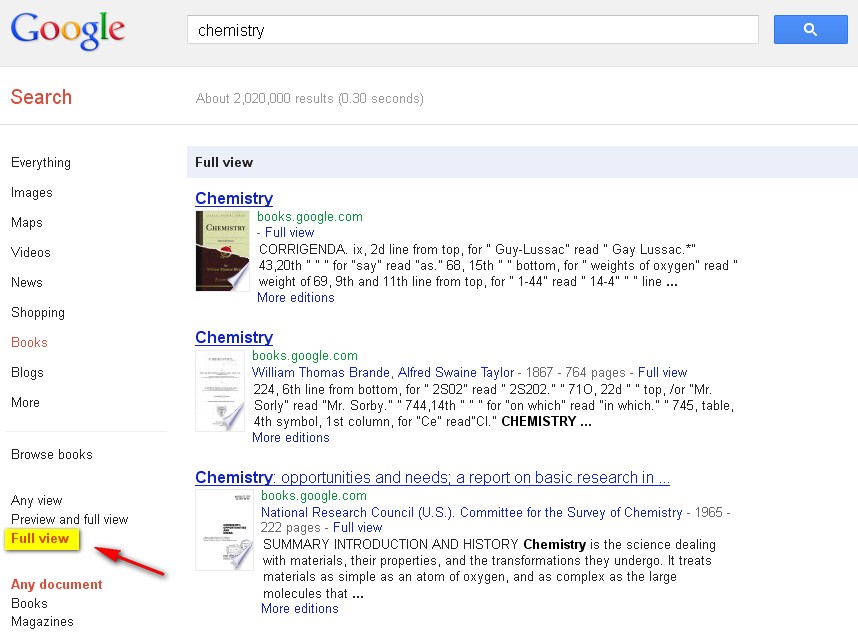
    در ابتدا به سایت Google Books بروید و کتاب مورد نظر خود را سرچ کنید. برای مثال ما در اینجا کلمه chemistry را سرچ کردیم.

    Google Books


    هنگامی که سرچ انجام شد، در صفحه باز شده چنانچه می خواهید فقط کتابهای کامل نمایش داده شوند بر روی گزینه Full view کلیک کنید.

    Full view


      اگر آماده‌سازی فایرفاکس را به درستی انجام داده باشید، در سمت چپ بالای صفحه باید دکمه‌ای به نام Download This Book برای دانلود تمام یا بخشی از صفحات کتاب و به موازات آن در سمت راست هم یک دکمه برای دانلود همان صفحه از کتاب وجود داشته باشد. 

    بر روی Download This Book کلیک کنید.

    Download This Book


    حالا صفحه شروع و پایانی که مد نظرتان هست را انتخاب کنید و سپس دکمه Get Download Links را کلیک کنید.

    Get Download Links


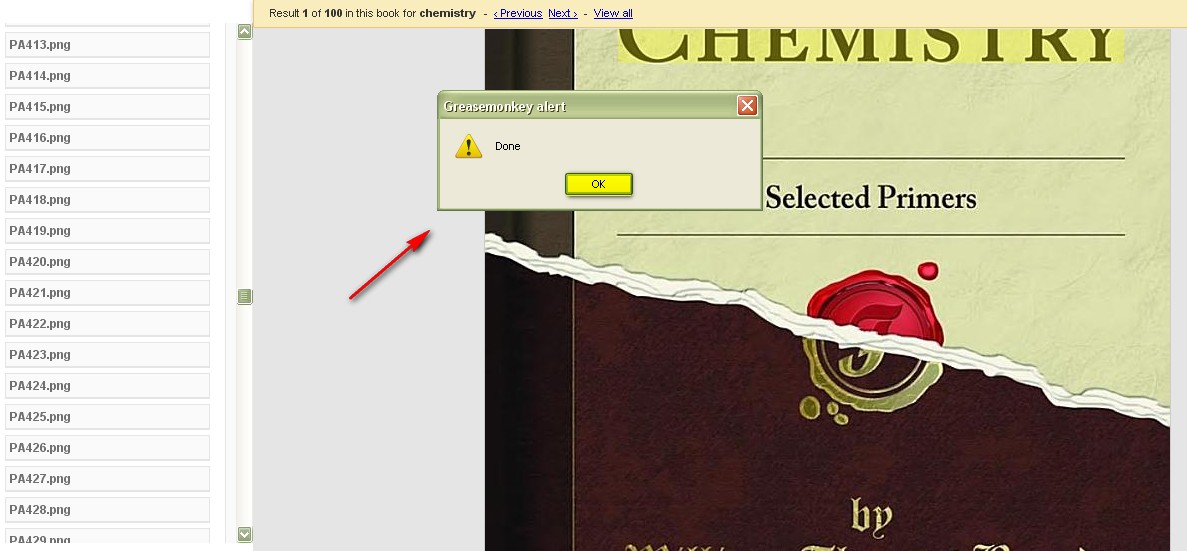
    زمانیکه تمام صفحات لیست شوند یک پیغام داده می شود که باید بر روی Ok کلیک کنید.

    Ok


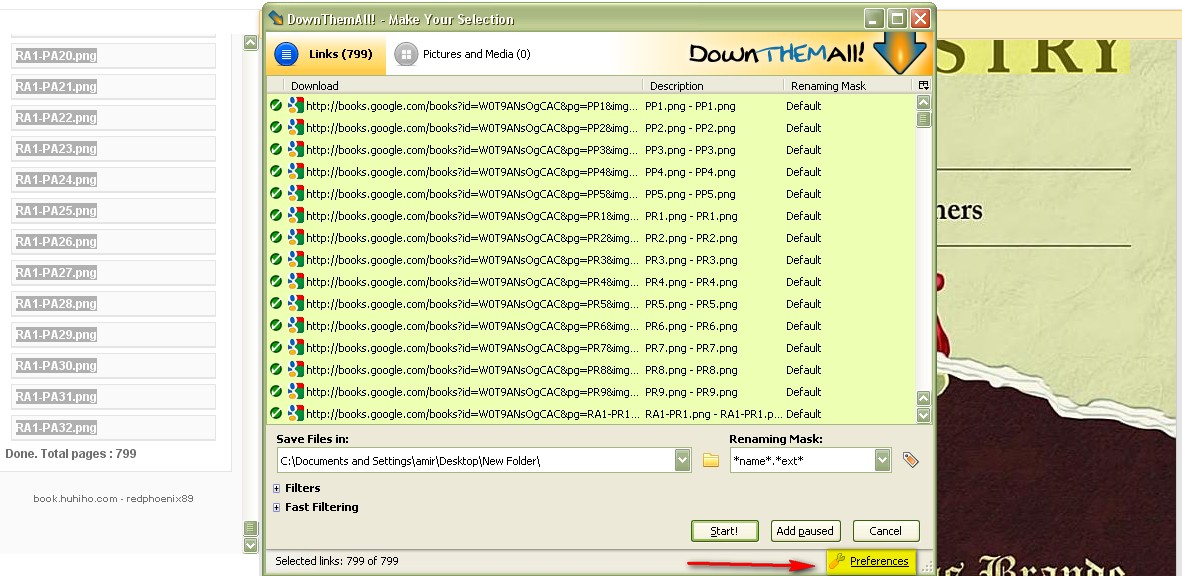
    همانطور که در شکل زیر می‌بینید، لینک دانلود تمامی صفحات کتاب برای دانلود در اختیار شما قرار گرفته است. حالا می‌توانید هر تعداد از این صفحات را که می‌خواهید انتخاب کرده و سپس بر روی آن کلیک راست کرده و گزینه‌ی DownThemAll را انتخاب کنید.

    DownThemAll


    در پنجره ای که باز می شود ابتدا بر روی گزینه Preferences کلیک کنید.

    Preferences


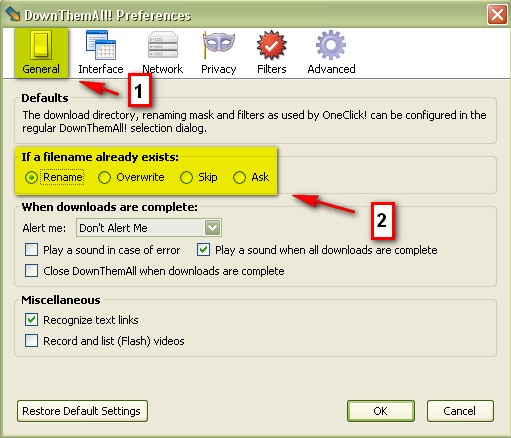
    برای اینکه صفحات به ترتیب دانلود شوند می توانید تنظیمات زیر را انجام دهید. بدین گونه که ابتدا با کلیک بر روی General در بخش نشان داده شده در شکل، گزینه Rename را انتخاب کنید.

    General


     سپس با کلیک بر روی Network ، مقدار Concurrent Downloads را بر روی 1 قرار دهید و سپس Ok  را بزنید.

    Concurrent Downloads


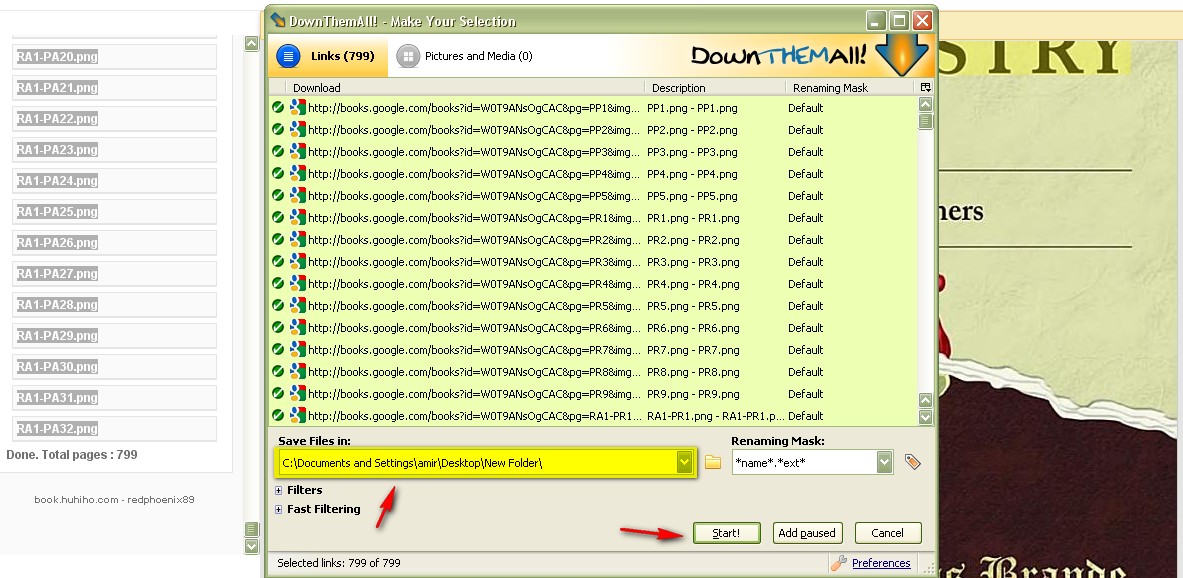
    همه لینک‌های تصاویر را انتخاب کرده و پس از آن محل ذخیره فایل ها را مشخص نمایید و در آخر هم دکمه Start را بزنید تا دانلود تمامی صفحاتی که انتخاب کرده بودید شروع شود.

    Start


    در نهایت، می توانید با استفاده از یک Convertor، تمام صفحات رو به PDF تبدیل کرده و آنها را به هم متصل نمایید تا تبدیل به یک کتاب با فرمت PDF شود و از مطالعه آن لذت ببرید.


    منبع : شیمی نوین

    معرفی و دانلود کتاب رئولوژی پلیمرها

    کتاب رئولوژی ویسکوالاستیک و پلیمر


    کتاب رئولوژی ویسکوالاستیک و پلیمر

    فهرست
    فصل اوّل: رئولوژی (Rheology)
    1-1 تاریخچه پیدایش رئولوژی 
    1-2 مواد از دیدگاه رئولوژی
    1-2-1 پدیده‌های رئولوژیکی
    1-2-2 تنش تسلیم در جامدات
    1-2-3 تنش تسلیم در رئولوژی
    1-2-4 تقسیم‌بندی مواد
    طبقه‌بندی سیالات

    فصل دوّم: آمیزه‌های پلیمری (Polymer Blends)
    2-1-1 مقدّمه
    2-1-2تعاریف
    2-1-3 روشهای تهیه آمیزه‌های پلیمری
    2-1-4 رفتار اجزاء آمیزه‌های پلیمری
    2-1-5 امتزاج‌پذیری آمیزه‌های پلیمری
    2-1-6 سازگای آمیزه‌های پلیمری
    1- استفاده از کوپلیمرها
    2- اضافه کردن پلیمرهای عامل‌دار 
    3- آمیزه‌کاری واکنشی 
    4- استفاده از حلال مشترک
    5- استفاده از تکنولوژی IPN 
    2-1-7 سازگاری بواسطه افزودن کوپلیمر
    2-1-8 روشهای تخمین سازگاری و امتزاج‌پذیری آمیزه‌ها و آلیاژهای پلیمری
    1- روشهای بر مبنای Tg
    2- روشهای میکروسکوپی
    3- روشهای طیف ‌سنجی
    الف) روش NMR
    ب- طیف سنجی IR
    2-1-9 کریستالیزاسیون آمیزه‌های پلیمری
    2-2-1 رئولوژی پلیمرها
    1- سیالات نیوتنی مستقل از زمان
    2- سیالات غیر نیوتنی تابع زمان
    3- سیالات ویسکوالاستیک
    ب) خواص ویسکوالاستیک
    2-2-2 رئولوژی آمیزه‌های پلیمری
    2-2-2-1 مقدمه
    2-2-2-2 ویسکوزیته آمیزه‌ها و آلیاژهای پلیمری
    2-2-2-3 معادلات تجربی ویسکوزیته آمیزه بر حسب غلظت سازنده‌های پلیمری
    2-2-2-4 جریان برشی پایدار آمیزه‌های پلیمری
    2-2-2-5 الاستیسیته مذاب آمیزه‌های پلیمری

    فصل سوّم: خاصیت ویسکوالاستیک خطّی (Linear viscoelasticity)
    3-1 مقدّمه
    3-2 مفهوم و نتایج حاصل از خاصیت خطیّت 
    3-3 مدل‌های ماکسول و کلوین 
    3-4 طیف اُفت یا آسایش 
    3-5 برش نوسانی
    3-6 روابط میان توابع ویسکوالاستیک خطی3-7 روش‌های اندازه‌گیری
    3-7-1 روش‌های استاستیک
    3-7-2 روش‌های دینامیک: کشش نوسانی
    3-7-3 روش‌های دینامیک: انتشار موج
    3-7-4 روش‌های دینامیک: جریان ثابت

    فصل چهارم: بررسی رفتار ویسکوالاستیک آمیزه های پلیمری با 
    استفاده از مدل امولسیون پالیریَن
    4-1 مقدمه
    4-2 مدل پالیریَن
    نتیجه گیری نهایی:


    منبع فایل اسکن شده این کتاب FTP دانشگاه تهران می باشد. این کتاب را می توانید از لینک های زیر دانلود نمایید.

    قسمت اول

    قسمت دوم

    قسمت سوم

    قسمت جهارم

    پسورد فایل ها: www.bezd.ir


    برچسب‌ها: دانلود کتاب رئولوژی پلیمرهاکتاب رئولوژی پلیمررئولوژی پلیمرهاUnderstanding Rheology,Download

    دانلود کتاب VISCOUS FLUID FLOW

    پيش فرض کتاب VISCOUS FLUID FLOW


    VISCOUS FLUID FLOW


    Tasos C. Papanastasiou
    Georgios C. Georgiou
    Andreas N. Alexandrou
    2000


    دانلود

    کتاب Blown Film Extrusion

    پيش فرض کتاب Blown Film Extrusion


    Blown Film Extrusion

    Kirk Cantor
    2006

    دانلود

    دانلود رایگان کتاب مباني شيمي پليمر

    دانلود رایگان کتاب مباني شيمي پليمر 
    نویسنده ::: ستار ارشدي